

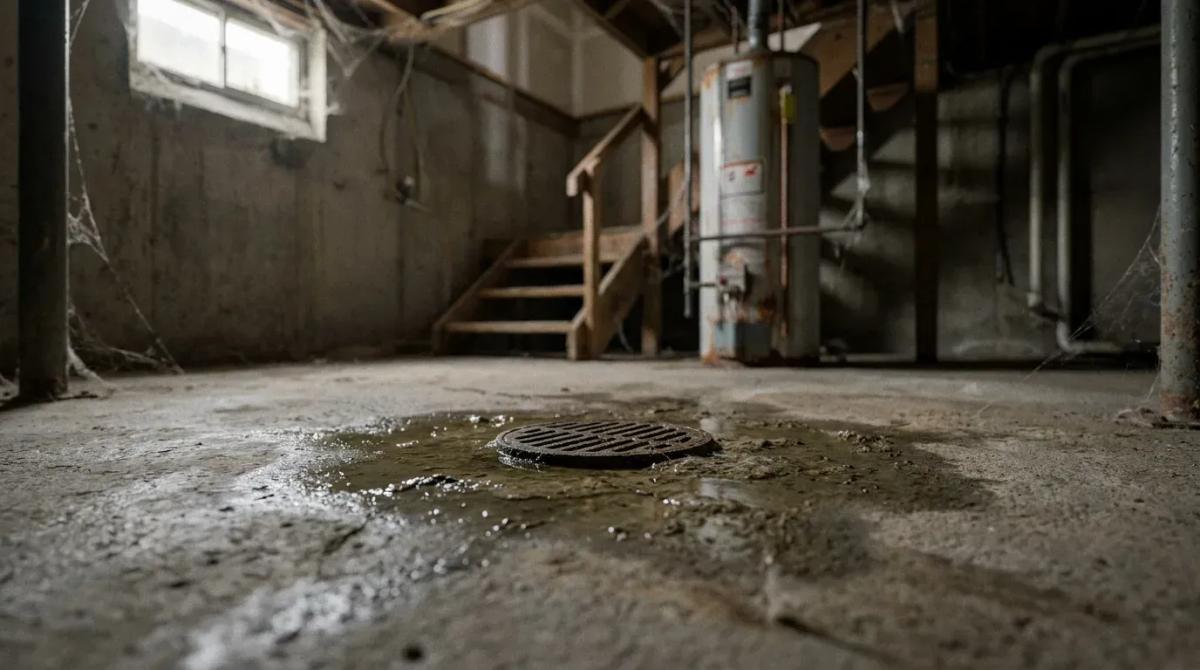
Sewage coming up through a basement floor drain is one of the worst things a house can do. What you do in the first hour matters for safety and for cleanup. What you do in the next week decides whether it happens again. This post covers both: what to do right away, how to tell where the problem is, and the repairs and devices that stop a repeat.
First: what to do right now
- Stop using water. Every flush, shower and load of laundry adds to what comes up. The City of Madison, Wisconsin puts it simply: "Do not use water in your home" during a backup (City of Madison).
- Stay safe around electricity. Madison advises unplugging electrical devices in wet areas. Don't step into standing water near outlets or appliances; if in doubt, call an electrician or the utility.
- Call your sewer utility and report it. They can check whether the public main is blocked.
- Call your insurance company before cleanup starts, and take photos.
Is it your line or the city's?
The answer decides who fixes it. A few signs help, though only your utility or a camera inspection can confirm it:
| What you see | Points to |
|---|---|
| Only your house is affected, and it started with slow drains | A blockage or defect in your own sewer lateral |
| Neighbors have backups too, often during heavy rain | A problem in the public sewer |
| The outside cleanout is full of water | A blockage downstream of the cleanout |
| The outside cleanout is dry while the basement drain backs up | A blockage between the house and the cleanout |
Most backups from a single house start in that house's own line. The City of Marietta, Georgia says nearly all service line blockages result either from material entering the sewer from the building or from root intrusion, and that clearing the blockage is the property owner's responsibility (City of Marietta). Rules differ by utility; see who owns the sewer lateral.
Backups from the public side happen too. The EPA lists blockages, line breaks, sewer defects that let stormwater and groundwater overload the system, power failures and improper design among the causes of sanitary sewer overflows, which can back up into homes (EPA, updated April 13, 2026).
Common causes in your own line
- Grease, wipes and paper that build up into a clog. The Cherokee County Water and Sewerage Authority in Georgia notes that cooking oil poured down household drains is hard to regulate and works to educate homeowners about it (CCWSA).
- Tree roots growing in through joints; see tree roots in a sewer line.
- A sag where waste collects; see bellied pipe.
- A broken or collapsed section, common in old clay, Orangeburg and cast iron lines.
Cleaning up safely
Sewage carries germs, so treat cleanup with care. Madison's guidance includes:
- Wear protective gloves and boots.
- Disinfect surfaces with a 1:10 solution of household bleach and water.
- Do not use ammonia (it reacts with bleach).
Porous items soaked by sewage, such as carpet, padding and upholstered furniture, are often not worth saving. For anything more than a small spill, a professional cleanup and restoration company is the safer choice. Keep receipts and photos for your insurer. Most standard policies don't cover backups without an added endorsement; Madison notes the same. See does homeowners insurance cover the sewer line.
Find the cause before you fix it
Once the line is flowing again, have it cleaned and filmed. A camera inspection shows whether the backup was a one-time clog or a sign of damage, and where the damage is. The camera inspection cost post explains what to ask for.
| What the camera finds | Usual fix |
|---|---|
| Grease or debris, pipe in good shape | Cleaning, such as hydro jetting, plus changes in what goes down the drain |
| Roots at one or two joints | Cleaning, then a spot repair |
| Cracks or roots along the line | CIPP lining |
| Collapsed or broken pipe | Pipe bursting or excavation of that section |
| A sag that holds water | Excavation to reset the slope |
Devices that help prevent a repeat
If the backup came from the public sewer, or your basement sits low, a device can stop sewage from coming in. The City of Lincoln, Nebraska lists several options (City of Lincoln):
- Check valve (backwater valve): "designed to allow sewage to only flow in one direction."
- Floor drain plug: one of the simplest and least expensive ways to block sewage at a floor drain.
- Floor drain standpipe: works only until sewage rises to the next opening in the house.
- Overhead sewer: a more involved change to how the basement drains.
Lincoln advises consulting a professional plumber or engineer before installing any of them, and many towns require a permit. A valve also needs care: Madison warns that one can stick open from lint, corrosion or debris unless it is inspected and maintained at least twice a year.
Questions to ask a contractor after a backup
- Was this a clog, or is the pipe damaged? Can I see the video?
- Where exactly is the problem, and is it on my side of the line?
- What would stop it from happening again: cleaning, a repair, or a backwater valve?
- Does a backwater valve need a permit here, and where would it go?
Frequently asked questions
Why does sewage come up through the basement floor drain first?
It is usually the lowest opening in the house, so when the line is blocked, water backs up there before anywhere else.
Should I pour chemical drain cleaner into a backed-up drain?
It's better not to. It rarely clears a main-line blockage, and it makes the water more hazardous for whoever clears and cleans it.
Will a backwater valve stop every backup?
It stops sewage flowing back in from the sewer, but it won't fix a clog or broken pipe in your own line. It also needs regular checks so it doesn't stick open.
Who pays if the city's sewer caused it?
That depends on the utility and the cause. Report it to the utility right away and ask about its claims process; keep photos and receipts.
Need the line cleared, filmed or repaired? Find a trenchless contractor who covers your area.