

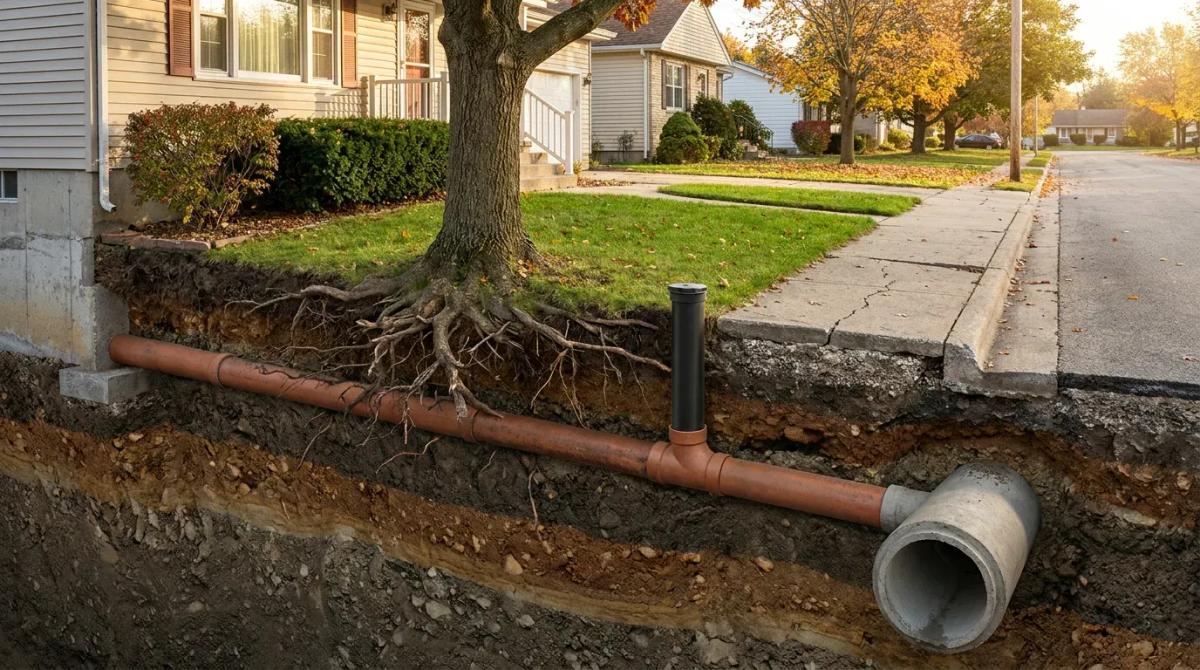
The sewer lateral is the pipe that carries everything from your toilets, sinks and drains out to the public sewer. When it cracks, sags or fills with roots, two questions come up at once: who has to pay for the repair, and does the yard have to be dug up to do it? The first depends on where you live. The second, more often than not, has a trenchless answer.
What the sewer lateral is
A lateral is usually a 4- to 6-inch pipe that runs underground from the house to the sewer main, which is typically under the street or an easement. The City of Columbus, Ohio describes laterals as "typically 4 to 6 inches in diameter" and notes that in older homes the lateral "is usually made of clay pipe which is subject to problems over time, such as becoming cracked or filled with tree roots" (City of Columbus).
Most laterals have a cleanout: a capped pipe that comes up to the surface near the house, near the property line, or in the basement. It is the access point for cleaning and camera work, and in many places it also marks where the owner's part of the line ends.
Who owns it: it depends on the utility
There is no national rule. Each sewer utility sets its own, and the lines are drawn in very different places. A few real examples:
| Utility | What the owner is responsible for |
|---|---|
| Pittsburgh Water (PA) | The entire lateral, from the house to the main, including the part under the street. The utility keeps the main and the wye fitting at the connection. |
| Gwinnett County (GA) | The lateral itself. Where there are two cleanouts, the one at the right-of-way is the County's to maintain and the one closer to the house is the owner's. |
| Jefferson Parish (LA) | The line from the house to the 6-inch cleanout near the sidewalk; the parish's responsibility starts there. |
| Charleston Water System (SC) | The sewer pipes in the yard, which are private plumbing; the customer pays for their repair. |
So a crack between the sidewalk cleanout and the main is the owner's bill in Pittsburgh and the parish's job in Metairie, which is in Jefferson Parish. Before you hire anyone, call your sewer utility and ask where its responsibility ends at your address, and whether it has a cleanout on record for you.
Some places also check laterals when a house is sold. In Bethel Park, Pennsylvania, a dye test and a camera inspection of the lateral are required before a deed transfer, and violations have to be fixed (Bethel Park). Nearby Monroeville requires a sewer certificate before a sale (Monroeville Code). If you are buying or selling, ask whether your town has a rule like this.
Why laterals fail
The EPA lists the age of the pipe system as an important factor in sewer failures: in older systems, "deteriorating main and lateral pipes and their joints can cause cracks and holes," and vitrified clay pipe can be more prone to cracking than some other materials (EPA). The usual problems:
- Open or cracked joints in clay pipe, where tree roots and groundwater get in.
- Deteriorated material: Orangeburg pipe that has flattened, or cast iron that has corroded.
- Sags (bellies), where a section has settled and water and waste sit in the low spot.
- Broken sections from shifting soil, heavy loads or earlier digging.
Leaks work both ways. Columbus explains that cracked laterals let rain water into sewers that weren't built to carry it, which can lead to "sewage overflowing into rivers or backing up into basements." That is why some utilities inspect or line private laterals at all.
Signs your lateral needs attention
- Several drains in the house are slow at the same time, or the lowest drain backs up first.
- Toilets gurgle when a washer drains or a tub empties.
- Clogs come back in the same spot after cleaning, often with roots on the cable.
- Sewage smell or a soggy patch in the yard along the sewer route.
- Water stands in the cleanout when nothing is running.
None of these says what is wrong or where. A camera inspection after the line is cleaned does: it shows the pipe material, each defect and how far it is from the cleanout.
How a lateral is repaired
The camera footage decides the method. Trenchless repairs work through the cleanout, a small pit, or from the main.
| What the camera shows | Usual repair |
|---|---|
| One or two bad joints in an otherwise sound pipe | Spot repair: a short liner over each defect |
| Cracks, roots or leaks along much of the line, pipe still round | CIPP lining of the whole lateral (see lateral pipe lining) |
| Collapsed, flattened or badly broken pipe | Pipe bursting to pull in new pipe, or excavation of that section |
| A sag that holds water | Excavation to fix the slope; a liner follows the old grade |
Columbus, which lines laterals in some neighborhoods, describes the lining process like this: a resin-filled liner is installed from the main through the lateral to the cleanout and hardened in place, and residents are asked not to use water for up to about four hours while it cures. If the pipe is too damaged for a liner to be pushed through, the yard is opened to expose and replace that section. Private contractors use the same basic approach, often working from a cleanout near the house.
For a sense of scale, Angi lists trenchless sewer repair at about $60–$250 per foot, CIPP lining at $80–$250 per foot and pipe bursting at $60–$200 per foot nationally (Angi, updated July 9, 2026). What your lateral costs depends on its length, depth, access, and whether part of it runs under a street. The cost guide goes through those factors.
Before you hire
- Ask the utility where your part ends, and whether it offers any lateral program in your area.
- Get the line cleaned and filmed, and keep the video. It is what any quote should be based on.
- Ask who pulls the permits. Work in the street or right-of-way usually needs one, and plumbing permits vary by town.
- Compare written quotes that name the method, the length of pipe and what happens at the connection to the main.
Questions to ask a contractor
- Where does my responsibility end, and does your repair stop there?
- Can the whole lateral be lined, or does a section need to be replaced first?
- How will you reconnect at the main or the wye?
- Will you install a cleanout if I don't have one?
- Do I get before-and-after video and a written warranty?
Frequently asked questions
Is the sewer line under the street my responsibility?
Sometimes. In Pittsburgh, the whole lateral to the main is the owner's. In Jefferson Parish, the parish takes over at the cleanout near the sidewalk. Your sewer utility can tell you where the line is drawn at your address.
Can a sewer lateral be repaired without digging?
Often. If the pipe still holds its shape, it can be lined from a cleanout or a small pit. Broken or collapsed sections may need bursting or a short excavation.
Does homeowners insurance pay for a lateral repair?
It depends on your policy and on what caused the damage. Ask your insurer, with the camera video in hand, before the work starts.
How do I find my cleanout?
Look for a capped pipe a few inches above the ground near the foundation or the front property line, or in the basement floor or wall where the main drain leaves the house. The utility may also have it on record.
Looking for help? Find a trenchless contractor who covers your area.
Sources
- City of Columbus, Ohio: Lateral Lining (Blueprint Columbus brochure)
- U.S. EPA: Preventing Stormwater Contamination from Sanitary Sewage
- Pittsburgh Water: Pipe ownership
- Gwinnett County, Georgia: Sewer lateral
- Jefferson Parish, Louisiana: Sewerage FAQ
- Charleston Water System: FAQ
- Bethel Park, Pennsylvania: Dye testing
- Monroeville, Pennsylvania: Code, sewer certification
- Angi: sewer line repair and replacement cost (updated July 9, 2026)