

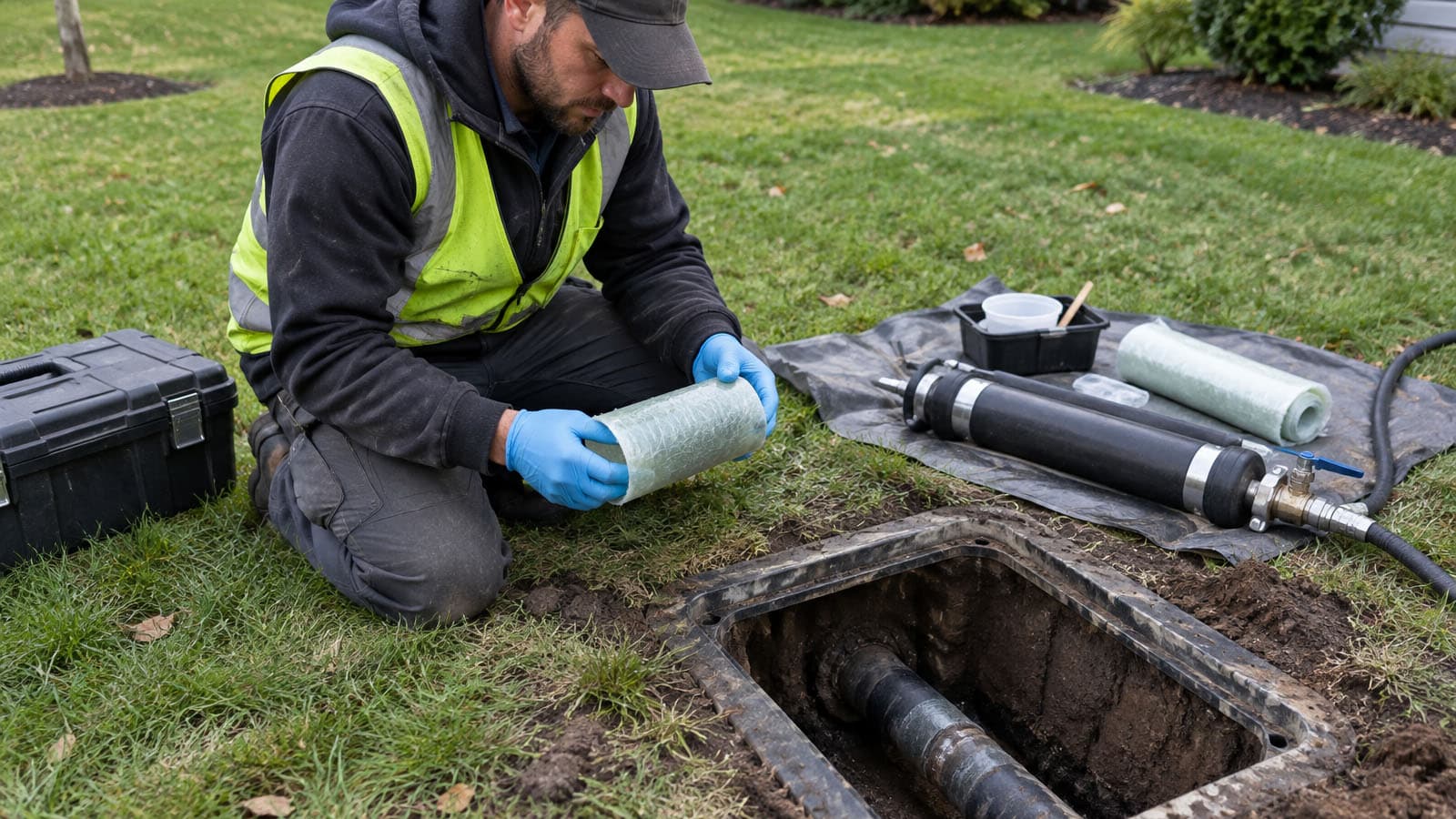
Spot Repair Techniques: Fix Isolated Pipe Damage Fast

Not every damaged sewer pipe requires complete rehabilitation. When problems concentrate at isolated points—a single cracked section, one failed joint, or localized root intrusion—spot repair techniques offer targeted solutions that address specific damage without the expense and scope of full-length lining. This focused approach proves particularly cost-effective when the remainder of the pipe system maintains good condition and doesn't require comprehensive rehabilitation.
Spot repair techniques provide targeted solutions within the broader spectrum of trenchless repair methods, addressing damage measuring 1-6 feet in length at specific locations. These precision repairs use the same proven technologies as full-length rehabilitation—CIPP lining, epoxy coatings, mechanical seals—but apply them only where needed. The result: property owners address immediate problems without paying for repairs the entire pipe system doesn't require.
The cost-effectiveness of spot repair becomes apparent in straightforward scenarios. A homeowner with a single cracked pipe section might spend $1,500-2,500 for a targeted patch, compared to $8,000-15,000 for full-length lining of an entire lateral or main line. When inspection reveals one or two problem areas in otherwise sound pipes, spot repair delivers the necessary fix at a fraction of comprehensive rehabilitation costs.
Understanding Spot Repair Technology
Spot repair—also called point repair or localized rehabilitation—addresses damage concentrated at specific pipe locations measuring 1-6 feet in length. This targeted approach makes sense when damage remains isolated rather than distributed throughout the pipe system, with the surrounding pipe maintaining adequate condition that doesn't require repair.
Typical Spot Repair Applications:
- Single cracked pipe sections: From ground settlement or impact damage
- Individual failed joints: Where pipes have separated or offset
- Isolated root intrusion areas: Root damage through specific weak points
- Localized corrosion: Concentrated at problem areas, not throughout the system
- Point source infiltration: Where groundwater enters at specific locations
The key distinction between spot-repairable versus system-wide problems lies in damage distribution. One or two isolated failures in otherwise sound pipe suggest localized issues suitable for spot repair. Multiple failures scattered throughout the system indicate deterioration requiring comprehensive rehabilitation.
Scope & Coverage:
Spot repair installs patches measuring 1-6 feet at specific damage locations, leaving undamaged pipe sections unlined. Full-length lining rehabilitates the entire pipe from access point to connection, regardless of where damage exists. This fundamental difference drives all other distinctions between the approaches.
Cost Comparison:
Spot repairs typically cost $1,000-3,500 per repair location, regardless of pipe length. Full-length CIPP lining runs $80-250 per linear foot, totaling $4,000-25,000+ for typical residential to commercial applications. For properties with one or two isolated problems, spot repair delivers 60-80% cost savings compared to full lining.
When Spot Repair Excels:
- 1-3 isolated damage points in otherwise sound pipes
- Budget-constrained situations requiring immediate problem resolution
- Properties planning near-term sales where comprehensive rehabilitation won't be recouped
- Interim solutions buying time until full rehabilitation budgets become available
Timeline Differences:
Spot repairs complete in 4-8 hours from start to finish. Full-length CIPP installations typically take 1-2 days for residential applications, longer for commercial projects. The faster timeline makes spot repair attractive for urgent problems requiring immediate resolution.

Spot Repair Methods & Technologies
CIPP spot patches use resin-saturated felt tube sections measuring 1-6 feet in length, with exact dimensions calculated to cover damage plus 6-12 inches overlap onto sound pipe on each end. This overlap ensures complete damage coverage and proper bonding to host pipe structure.
Installation Methods:
Inversion: Employs a packer device positioned at the repair location, with the patch tube inverted into place using water or air pressure.
Pull-through: Mechanically positions patches using cables and winches. Both approaches require precise positioning to ensure damage coverage and proper overlap.
Curing Process:
Curing follows the same procedures as full CIPP installations. Hot water circulation (most common) typically takes 2-4 hours for spot patches given their shorter length and reduced thermal mass. Once cured, the patch creates permanent structural reinforcement bonded to the host pipe.
Advantages: Structural reinforcement, 20-30 year warranties, root-proof finish, chemical resistance
Cost Range: $1,500-3,000 per patch
Mechanical Repair Systems:
Mechanical repairs use press-fit sleeves, link-seals, or expansion bands that mechanically seal damaged sections without resin curing requirements. These systems install faster than CIPP patches and cost less upfront ($1,000-2,500 typical), but may not provide equivalent long-term durability or structural reinforcement.
Best applications: Infiltration-only problems, emergency temporary repairs, situations where CIPP curing time is problematic
Internal Pipe Coatings:
Spray-applied or brush-applied epoxy coatings seal small cracks, pinholes, and minor corrosion without adding significant structural reinforcement. These thin coatings (typically 10-40 mils) work best for preventative applications or sealing minor defects discovered during inspection.
Application methods: Robotic spray equipment for precision application, brush application for accessible areas
Cost Range: $800-2,000 per repair area

The Spot Repair Process
Phase 1: Damage Assessment
Every successful spot repair begins with thorough diagnostic work confirming that isolated damage exists, identifying exact locations and extents, and verifying that spot repair represents the appropriate solution. Comprehensive video inspection documents the entire pipe system, not just the obviously damaged areas.
Phase 2: Site Preparation
Localized cleaning around the damage area removes debris, scale, and foreign material that would prevent proper repair adhesion or installation. High-pressure jetting typically cleans 10-15 feet of pipe centered on the damage location—adequate to provide clean repair surfaces plus working room.
Phase 3: Repair Installation
For CIPP patches, contractors position inflation packers at repair locations using distance measurements from inspection. They invert or pull patches into position, ensuring proper coverage of damage plus adequate overlap onto sound pipe. Inflation pressure holds patches against pipe walls during curing.
For mechanical repairs, technicians position sleeves or bands over damaged sections and expand them mechanically to create compression seals against pipe walls.
Phase 4: Verification
Post-repair camera inspection confirms complete damage coverage, proper patch positioning, adequate overlap, and successful sealing. This documentation verifies repair quality and provides warranty support. Most contractors include this final inspection as standard practice.
When to Choose Spot Repair
Perfect Spot Repair Candidates:
- 1-3 isolated damage points: Discrete failures separated by sound pipe
- Single failed joint or crack: Individual, well-defined problems
- Recent damage from specific event: New crack from ground shift or impact
- Root-damaged areas: Isolated intrusions through specific sections
- Budget constraints: Immediate repair needed within limited funds
- Strategic interim solution: Addressing critical problems while planning comprehensive work
Break-Even Analysis:
As a general guideline, 3-4 spot repairs approach the break-even point where full-length lining becomes more cost-effective. A single spot repair costs $1,500-3,000, so four repairs total $6,000-12,000—approaching or exceeding full-length CIPP lining costs of $6,000-15,000 for typical residential applications.
Situations Requiring Comprehensive Rehabilitation:
- Multiple distributed failures: 5+ damage points scattered throughout pipe sections
- Widespread deterioration: General pipe condition showing age-related breakdown
- Material failure: Pipe material itself breaking down (brittle clay, corroded cast iron)
- Future sale planned: Comprehensive solution adds more property value
- Long-term ownership: Full rehabilitation provides better 50-100 year solution
When inspection reveals 5+ damage points scattered throughout pipe sections, the pattern suggests system-wide deterioration rather than isolated failures. Addressing these multiple points with individual spot repairs creates total costs approaching full-length CIPP rehabilitation while leaving untreated pipe that will likely fail next.
Spot Repair Costs
Cost by Method:
| Repair Method | Cost Range | Best Applications |
|---|---|---|
| CIPP Patches | $1,500-3,000 | Structural damage, long-term solution |
| Mechanical Repairs | $1,000-2,500 | Infiltration, temporary fixes |
| Coating Applications | $800-2,000 | Minor cracks, preventative sealing |
| Emergency Repairs | $1,200-3,500 | Urgent failures requiring immediate fix |
Cost Factors:
- Pipe diameter: Larger pipes require more material (20-30% premium for 8"+ vs 4-6")
- Repair length: Longer patches cost more ($300-500 per additional foot)
- Access difficulty: Challenging locations add labor time ($200-600 premium)
- Damage severity: Extensive preparation adds costs ($200-500 extra)
- Cure method: Hot water systems may cost more than ambient cure
Frequently Asked Questions
Most spot repairs complete in 4-8 hours from start to finish, including inspection verification, localized cleaning, repair installation, curing (if required), and final testing. CIPP patches using hot water cure take 4-6 hours total, mechanical repairs can finish in 2-4 hours, and coating applications require 3-5 hours. This single-day timeline contrasts with 1-2 day installations for full-length lining.
Yes, spot repair works well on cast iron pipes showing isolated damage. CIPP patches bond effectively to cast iron surfaces when properly prepared, creating structural reinforcement that can extend pipe life 20-30+ years. However, if cast iron shows widespread corrosion or multiple failures throughout its length, full-length lining or replacement becomes more appropriate than multiple spot repairs.
The break-even point typically occurs around 3-4 spot repairs. Beyond this number, the cumulative cost approaches full-length lining expenses while leaving untreated pipe that may fail next. If inspection reveals 5+ damage points, full-length CIPP lining usually provides better long-term value. Additionally, multiple repairs suggest systemic problems rather than isolated failures, indicating the pipe system requires comprehensive rehabilitation.
Spot repairs typically last 10-30 years depending on method and installation quality, with CIPP patches carrying 20-30 year warranties. This compares to 50-100 year lifespans and warranties for full-length CIPP lining. The difference stems from limited overlap areas and localized loading at spot repairs versus continuous structural support provided by full-length rehabilitation. However, for isolated damage in otherwise sound pipes, spot repairs deliver excellent long-term value.
CIPP spot patches create root-proof barriers at repaired locations, preventing re-intrusion through those specific areas. However, roots may still enter through other joints or cracks in unrepaired sections. For properties with aggressive root problems affecting multiple locations, full-length lining provides comprehensive root protection throughout the entire pipe system.
Yes, spot repairs work year-round including winter months. The underground environment maintains relatively stable temperatures, and hot water curing systems function effectively even when surface conditions are freezing. Mechanical repairs and coating applications also proceed without weather restrictions. This all-season capability makes spot repair valuable for addressing urgent winter failures.
Conclusion: Strategic Use of Spot Repair
Spot repair techniques provide valuable options within comprehensive pipe rehabilitation strategies, offering cost-effective solutions for isolated damage when full-length lining exceeds budget or necessity. The targeted approach excels in appropriate applications—1-3 discrete failures in otherwise sound pipes—while proving inadequate when systemic deterioration affects entire pipe systems.
Success with spot repair requires accurate damage assessment confirming isolated problems, proper method selection matching repair needs to technology capabilities, skilled installation ensuring complete damage coverage and adequate overlap, and realistic expectations about when spot repair makes sense versus comprehensive rehabilitation.
For isolated problems in otherwise sound systems, spot repair delivers focused solutions at a fraction of comprehensive rehabilitation costs. The 4-8 hour installation timeline, targeted expense, and proven performance make spot repair an essential tool for maintaining aging infrastructure while managing budget constraints strategically.
Need Expert Assessment?
Connect with experienced contractors who can inspect your pipes, identify damage patterns, and recommend whether spot repair or comprehensive rehabilitation best serves your needs.
Find Qualified Contractors