

Pipe Coating Technology: Spray-Applied Corrosion Protection
.png)
⚠️ CRITICAL: Coating ≠ Structural Repair
Pipe coating provides ZERO structural strength. Use only for protection, never for rehabilitation.
Pipe coating technology addresses a fundamentally different problem than structural rehabilitation methods like CIPP pipe lining. Rather than reinforcing deteriorated pipes, coating protects structurally-sound pipes from ongoing corrosion, chemical attack, or environmental degradation. This protective rather than rehabilitative approach suits specific scenarios where pipes maintain adequate strength but face active corrosion that will eventually cause failure without intervention.
The critical distinction between coating and lining determines when each technology applies. Coating provides thin protective barriers—typically 20-60 mils (0.5-1.5mm) thick—that shield pipe surfaces from corrosive environments. These spray-applied layers offer no structural reinforcement and require sound host pipes capable of carrying all loads independently. In contrast, structural lining methods like CIPP create thick (3-10mm) reinforced barriers that can rehabilitate even severely deteriorated pipes by providing independent load-carrying capacity.
When protection beats rehabilitation becomes clear through cost-benefit analysis. Coating structurally-sound pipes facing active corrosion costs $30-100 per linear foot—50-70% less than structural rehabilitation while extending service life 15-30 years. This economic advantage makes coating attractive for preventive maintenance programs, protecting recently-installed pipes, or addressing corrosion in pipes years from structural failure. However, attempting to coat structurally-compromised pipes wastes money on a solution that cannot address the fundamental problem. For comprehensive comparison of all available trenchless repair methods, understanding each technology's appropriate application prevents costly misapplication.
Understanding Pipe Coating Technology
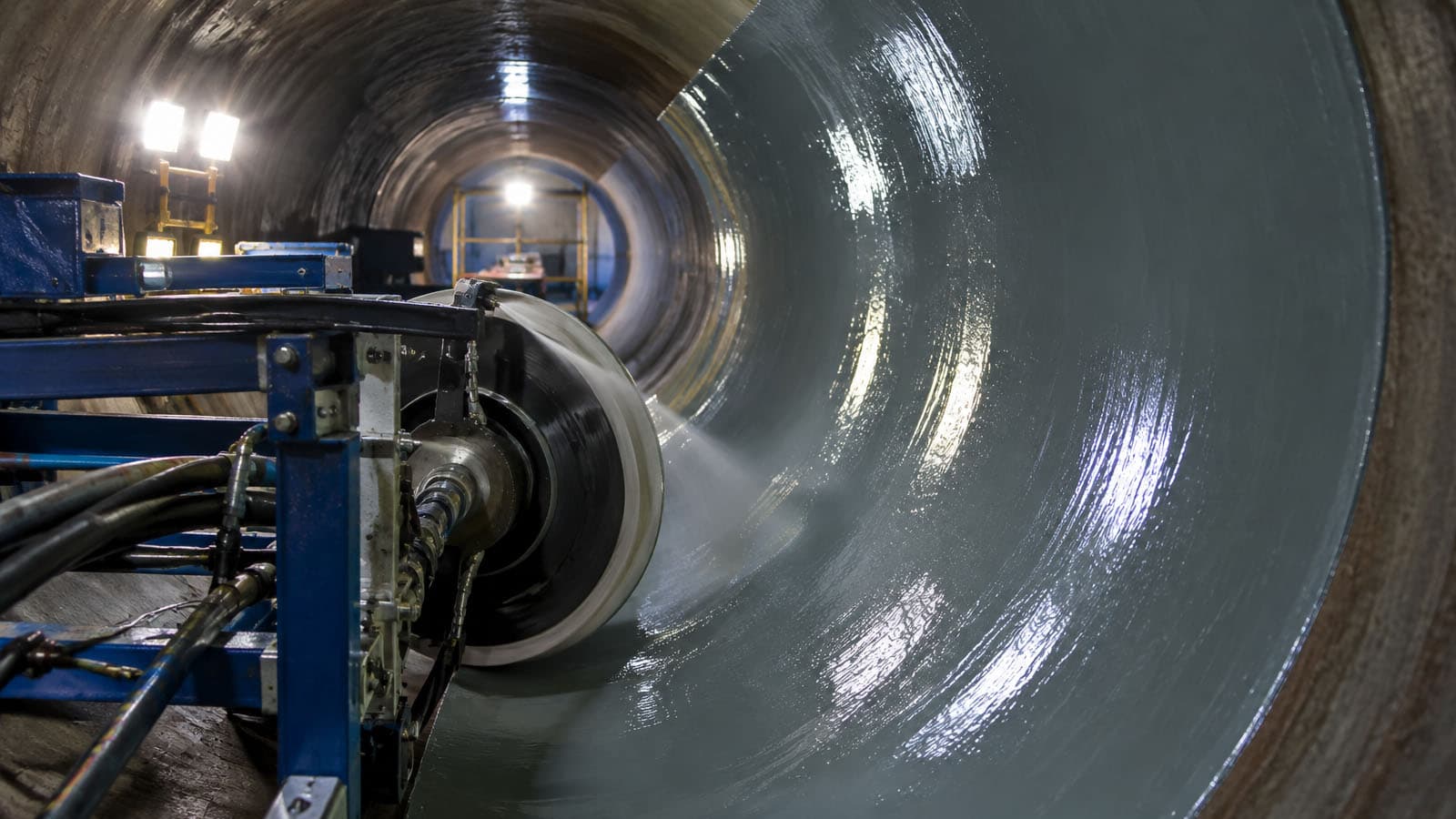
Pipe coating creates thin protective barriers between pipe surfaces and corrosive environments through spray-applied epoxy or polymer systems. The coating process uses specialized equipment—typically centrifugal spray heads or robotic applicators—to apply uniform coatings remotely from manholes or access points, eliminating excavation requirements.
Application Process:
Application involves multiple thin passes building to specified thickness, typically 20-60 mils (0.5-1.5mm or roughly 1/32 to 1/16 inch). This thin layer provides chemical barrier properties preventing corrosive substances from contacting pipe surfaces, while the coating itself resists chemical attack through formulation design. Modern epoxy systems offer excellent resistance to hydrogen sulfide gas (common in sewers), acids, bases, and various industrial chemicals depending on specific formulations.
⚠️ Non-Structural Nature:
CRITICAL LIMITATION: The non-structural nature proves both advantage and limitation. Coating adds negligible weight, causes minimal diameter reduction (typically 1-3%), and doesn't alter pipe structural behavior. However, this also means coating provides absolutely zero structural reinforcement—pipes must retain 80-90% of original structural capacity independently. Attempting to coat structurally-deficient pipes represents inappropriate technology application that wastes money while failing to address the fundamental problem.
| Feature | Pipe Coating | CIPP Structural Lining |
|---|---|---|
| Primary Purpose | Protection from corrosion | Structural rehabilitation |
| Thickness | 0.5-1.5mm (20-60 mils) | 3-10mm (6-20x thicker) |
| Structural Strength | ZERO - Protection only | Independent load capacity |
| Host Pipe Requirement | 80-90% integrity minimum | Can repair severely damaged |
| Diameter Reduction | 1-3% (minimal) | 3-6% (moderate) |
| Application | Centrifugal spray | Liner installation & curing |
| Cost | $30-100/ft | $80-250/ft |
| Lifespan | 15-30 years protection | 50-100 years structural |
| Best Application | Sound pipes with corrosion | Deteriorated pipes needing repair |
Understanding all available trenchless rehabilitation options ensures selecting the right approach for specific pipe conditions. Coating serves protective purposes exclusively—arresting active corrosion, preventing future corrosion initiation, or shielding pipes from specific chemical environments. The thin barriers (0.5-1.5mm) lack structural capacity and depend entirely on host pipe strength.

Coating Materials & Application Methods
Two-Part Epoxy Systems:
Two-part epoxy formulations dominate pipe coating applications due to their excellent chemical resistance, adhesion properties, and proven performance. These systems combine resin and hardener components just before application, initiating chemical cross-linking that creates the protective barrier. The working time (pot life) ranges from 30 minutes to several hours depending on formulation, allowing adequate time for application while ensuring proper cure.
Chemical Resistance Properties:
Chemical resistance properties suit sewer environments where hydrogen sulfide gas, acids from industrial discharge, and various chemicals challenge pipe materials. Properly-formulated epoxy coatings resist these aggressive substances, preventing the corrosion that would otherwise attack unprotected cast iron, steel, or concrete pipes.
Polyurethane & Polymer Alternatives:
Polyurethane systems offer flexibility advantages over rigid epoxies, accommodating minor pipe movement or thermal expansion without cracking. However, chemical resistance typically proves inferior to epoxy for aggressive sewer environments. Various polymer coatings target specific applications—water mains, industrial process pipes, or specialty chemical exposures—with formulations optimized for particular resistance requirements.
Centrifugal Spray Coating:
Centrifugal spray coating represents the most common application method, using rotating spray heads mounted on equipment that traverses pipes from manhole access. The centrifugal force distributes coating material uniformly around pipe circumferences, building thickness through multiple passes. This remote application capability allows coating pipes without entry, reducing safety concerns and enabling work in smaller diameter pipes where human entry proves impossible.
Robotic Application Systems:
Robotic application systems provide advanced automation for consistent application quality and complex navigation capability. These systems incorporate cameras for operator visibility, automated thickness control, and sophisticated movement systems handling bends and irregularities. The premium equipment costs limit availability to specialized contractors, though the quality and efficiency benefits often justify the investment for larger projects.
Manual Application Methods:
Manual coating application remains relevant for accessible larger-diameter pipes, special circumstances, or small projects where robotic equipment costs prove prohibitive. Technicians enter pipes using confined space safety protocols, applying coating with spray guns or rollers. While labor-intensive, manual methods provide flexibility for complex conditions or rehabilitation work requiring human judgment.
The Coating Application Process
⚠️ CRITICAL SUCCESS FACTOR:
Coating success depends critically on surface preparation exceeding that required for structural lining. The thin coating layers cannot bridge surface defects or contamination—they must adhere intimately to clean, dry, properly-profiled surfaces for long-term performance. Inadequate surface preparation represents the primary cause of coating failure, regardless of coating material quality or application technique.
Extreme Cleaning Requirements:
Cleaning requirements prove extreme compared to CIPP preparation. Beyond removing debris and roots, coating demands eliminating all grease, oil films, mineral deposits, and foreign substances. Many projects use multi-stage cleaning: mechanical brushing or scraping, high-pressure jetting with detergent solutions, and final rinse with potable water. Video inspection after cleaning verifies adequate preparation before coating application proceeds.
Drying & Surface Profiling:
Drying requirements prove absolute—any surface moisture prevents proper coating adhesion and causes eventual failure. Forced air drying equipment removes water, with moisture meters confirming dry conditions before coating. Surface profiling through grit blasting or mechanical abrasion creates texture for coating adhesion. Smooth surfaces offer inadequate bonding area; proper profiling increases surface area and provides mechanical interlocking for coating attachment.
Phase 2: Multi-Pass Application
Application proceeds through multiple thin passes building to specified thickness. Applying thick coatings in single passes causes runs, sags, or incomplete curing. The multi-pass approach allows each layer to gel partially before subsequent passes, creating uniform thickness throughout pipe lengths. Equipment calibration and monitoring ensure consistent material application rates and proper coverage.
Phase 3: Curing Process
Curing transforms applied coating from liquid to solid protective barrier through chemical cross-linking reactions. Ambient cure methods rely on room temperature reactions over 24-48 hours, while accelerated cure uses heat to complete reactions in 4-8 hours. Temperature and humidity control during curing ensures proper reaction completion and optimal coating properties. Rushing curing or applying coatings in extreme conditions compromises performance.
Phase 4: Quality Verification
Quality verification includes holiday testing using electrical devices detecting pinholes or thin spots, thickness measurements at multiple locations confirming specification compliance, and adhesion testing verifying proper bonding. These quality control steps identify defects requiring repair before project acceptance. Final video inspection documents complete coverage and coating quality for warranty purposes.

When Coating Works Best
Perfect Coating Candidates
Structurally sound pipes (80-90%+ integrity) with active corrosion or requiring preventive protection
Structurally Adequate Host Pipes:
Structurally adequate host pipes represent the fundamental requirement—coating cannot and will not reinforce weak pipes. Video inspection must confirm pipes retain at least 80-90% of original structural capacity with no significant cracks, breaks, or deformation. Active corrosion in otherwise sound pipes represents ideal coating applications: cast iron water mains showing interior tuberculation but maintaining wall thickness, concrete sewers with hydrogen sulfide attack on surfaces but sound structural walls, steel pipes with surface rust before significant wall loss occurs.
Pipe Types Suited for Coating:
- Cast iron water mains: Interior tuberculation, active corrosion, but adequate wall thickness
- Concrete sewers: Hydrogen sulfide attack, acid corrosion on surfaces
- Steel process pipes: Chemical exposure, surface oxidation in early stages
- Recently-installed pipes: Preventive protection before corrosion starts
- Rehabilitated pipes: Protecting structural repairs from future corrosion
Major Advantages:
- 50-70% cost savings: $30-100/ft versus $80-250/ft for CIPP
- Minimal diameter reduction: 1-3% versus 3-6% for structural lining
- Preventive protection: Extends service life 15-30 years economically
- Chemical barrier: Excellent resistance to H2S, acids, corrosive environments
- Smooth surface: Improves flow characteristics, reduces friction
- Fast application: Multiple pipes per day with robotic equipment
- Remote installation: No confined space entry required
⚠️ NEVER Use Coating For:
- Cracked or broken pipes: Coating provides ZERO structural repair
- Pipes below 80% structural integrity: Cannot reinforce weak pipes
- Severely deteriorated pipes: Need structural rehabilitation, not protection
- Active leaks: Coating cannot seal significant water infiltration
- Deformed or collapsed sections: Requires structural intervention
The Non-Structural Limitation:
The non-structural nature proves the defining limitation—coating provides zero reinforcement and requires structurally-sound host pipes. Attempting to coat cracked, broken, or structurally-deficient pipes wastes money on inappropriate technology. Surface preparation demands exceptional rigor exceeding other methods, with inadequate preparation causing coating failure regardless of application quality.
Thickness Limitations:
The thin barriers cannot bridge gaps, cracks, or significant surface irregularities. Unlike CIPP's thick structural liners that can span defects, coating conforms to substrate surfaces and provides only chemical isolation between pipe materials and corrosive environments.
Pipe Coating Costs & Economics
Cost Range:
Pipe coating typically costs $30-100 per linear foot depending on diameter, thickness specifications, access difficulty, and preparation requirements. This represents 50-70% savings compared to CIPP's $80-250 per foot range. The cost advantage stems from thinner materials, simpler application equipment, and faster installation procedures.
Cost Factors:
- Pipe diameter: Larger diameters require more material per foot
- Coating thickness: Thicker specifications (40-60 mils) cost more than thin (20-30 mils)
- Surface preparation intensity: Heavily contaminated pipes increase cleaning costs
- Access difficulty: Deep installations or limited access add expense
- Project length: Longer runs dilute mobilization costs per foot
- Application method: Robotic systems cost more than manual but offer efficiency
Economic Advantage:
For structurally-adequate pipes facing corrosion, coating delivers exceptional value. Extending service life 15-30 years at 50-70% savings versus structural rehabilitation makes coating attractive for preventive maintenance programs and budget-conscious projects. However, this economic advantage disappears if coating is misapplied to structurally-deficient pipes requiring actual rehabilitation.
Frequently Asked Questions
No, pipe coating provides no structural strength—it's protective only. Coating creates thin barriers (0.5-1.5mm) preventing corrosion but adds zero load-carrying capacity. CIPP creates thick structural liners (3-10mm) that can rehabilitate even severely deteriorated pipes. Use coating only for structurally-sound pipes needing protection, never for pipes requiring structural reinforcement. This distinction is absolutely critical to appropriate technology selection.
Pipe coating measures 0.5-1.5mm (20-60 mils) thick—roughly 1/32 to 1/16 inch. CIPP structural lining measures 3-10mm thick—6-20 times thicker than coating. This dramatic thickness difference explains why CIPP provides structural capacity while coating offers only protection. The thin coating reduces diameter by just 1-3% versus CIPP's 3-6% reduction, but provides none of the structural benefits that justify CIPP's greater thickness.
No, coating cannot repair cracked pipes. The ultra-thin coating layers (0.5-1.5mm) cannot bridge cracks, seal breaks, or provide any structural reinforcement. Coating simply conforms to pipe surfaces, creating chemical barriers but adding no strength. Attempting to coat cracked pipes misapplies protective technology to situations requiring structural rehabilitation. Cracked pipes need CIPP lining, pipe bursting, or traditional replacement—never coating.
Coating protects sound pipes from corrosion with thin barriers (0.5-1.5mm), while lining rehabilitates deteriorated pipes with thick structural reinforcement (3-10mm). Coating offers zero strength and requires pipes retaining 80-90% structural capacity. Lining provides independent load-carrying ability and can repair severely damaged pipes. Coating costs $30-100/ft for protection; lining costs $80-250/ft for rehabilitation. Choose coating for corrosion prevention in sound pipes, lining for structural repair of damaged pipes.
Properly-applied pipe coating typically lasts 15-30 years when protecting structurally-adequate pipes from corrosion. Performance depends critically on surface preparation quality, coating thickness, and environmental conditions. Coating protects pipes from active corrosion during this period but provides no structural reinforcement. After 15-30 years, recoating may extend protection further, or pipes may require structural rehabilitation if deterioration has progressed beyond coating's protective capabilities.
Yes, when NSF-certified epoxy coatings are used. NSF/ANSI Standard 61 certifies coating materials for potable water contact, ensuring they don't leach harmful substances. Water utilities commonly coat cast iron water mains with NSF-61 certified epoxies, protecting against tuberculation and corrosion while maintaining water quality. Always specify NSF-61 certified materials for drinking water applications and verify certifications before application. Sewer coatings don't require NSF certification since they don't contact potable water.
Conclusion: Coating as Protective Strategy
Pipe coating technology serves the specific niche of protecting structurally-adequate pipes from corrosion and chemical attack. When applied appropriately—to sound pipes facing active corrosion—coating delivers cost-effective protection extending service life 15-30 years at 50-70% savings versus structural rehabilitation. However, attempting to coat structurally-deficient pipes misapplies protective technology to situations requiring rehabilitation, wasting money while failing to address fundamental problems.
Understanding when coating represents the right solution requires honest pipe condition assessment and clear distinction between protection and rehabilitation needs. Structurally-sound pipes with active corrosion, preventive maintenance programs, and budget-constrained projects favor coating. Pipes with cracks, breaks, or inadequate structural capacity require rehabilitation methods offering structural reinforcement—CIPP lining, pipe bursting, or traditional replacement. For comprehensive comparison of all available approaches, explore our complete guide to trenchless methods.
Success with pipe coating depends on exceptional surface preparation, appropriate technology selection, and realistic performance expectations. The investment in coating protects valuable infrastructure economically when applied to appropriate candidates, preventing corrosion progression that would eventually necessitate far more expensive structural rehabilitation or replacement.
Need Corrosion Protection Assessment?
Connect with experienced contractors offering pipe coating services for corrosion protection and preventive maintenance programs.
Find Coating Specialists