

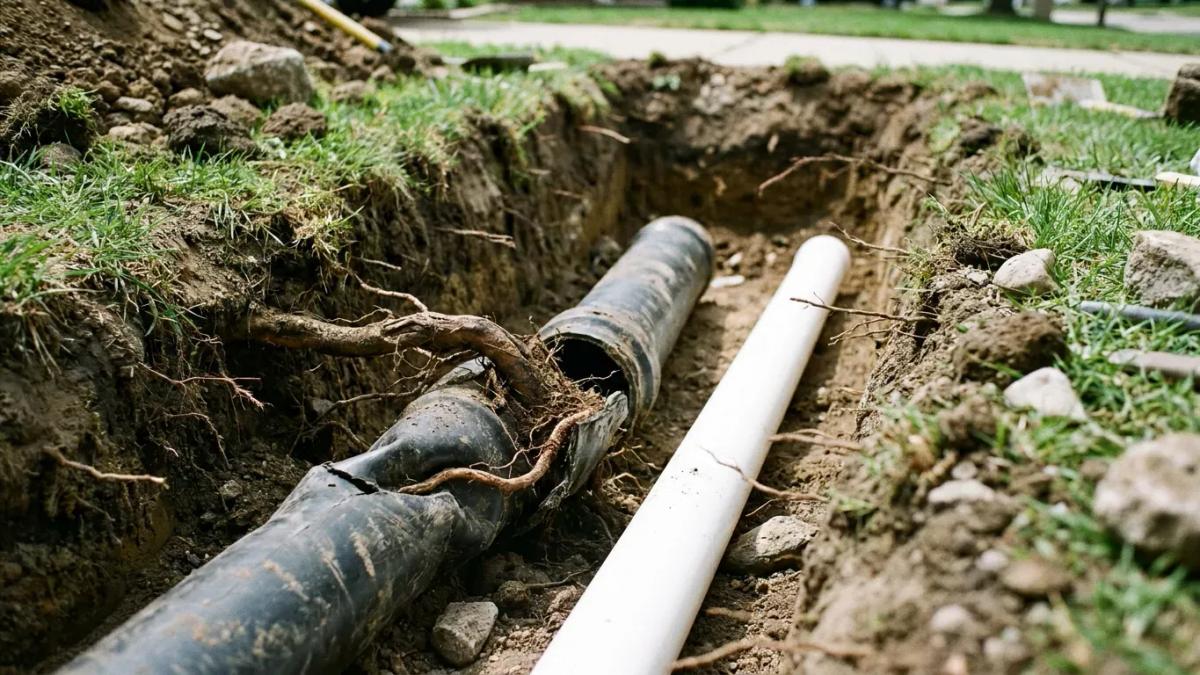
Orangeburg pipe is a fiber sewer pipe made of wood or plant fibers soaked in coal tar pitch. It was installed in many homes built from the late 1940s to the early 1970s, and much of it is still in the ground. If your house is from that era and the main sewer line keeps clogging, Orangeburg is one of the first things to rule out.
What Orangeburg pipe is
"Orangeburg" was a brand name that became the common name for bituminized fiber pipe. It was made in layers of ground fibers bound with a water-resistant adhesive and impregnated with liquefied coal tar pitch (Wikipedia). The City of Ann Arbor describes the same material as plant fibers and asbestos soaked in a tar-like substance (City of Ann Arbor).
The name comes from Orangeburg, New York, home of the Fiber Conduit Company, which became the Orangeburg Manufacturing Company in 1948. Several other companies made the same kind of pipe.
When it was used
Fiber pipe was cheap, light and easy to cut with a hand saw. Demand grew during World War II, when metal was scarce, and again in the postwar housing boom. Michigan's Plumbing Board approved it for sewers on November 1, 1949, and Ann Arbor removed it from its list of approved sewer materials in May 1970. PVC and ABS plastic pipe took its place during the 1970s.
So the homes most likely to have it were built from the late 1940s through the early 1970s. Many neighborhoods we cover fall in that window: in Warren the median home dates from 1965, in Livonia from 1964 and in Dearborn from 1952 (U.S. Census Bureau, American Community Survey 2020–2024). A build year in that range doesn't prove a home has Orangeburg, since builders also used clay and cast iron, but it's a reason to check.
How it fails
Fiber pipe softens and loses strength as it ages. Ann Arbor's building department lists the problems it sees:
- Flattening. The weight of the soil pushes the pipe out of round, which slows flow and catches solids.
- Separated joints. Shifting soil pulls sections apart, usually at the joints.
- Roots. Tree roots enter at the joints, then loosen or break the pipe.
- Chemical damage. Solvents, paint thinner, mineral spirits and adhesive cleaners poured down drains speed up the decay. A pipe can look round from the outside while failing inside.
Once a fiber pipe starts to deform, problems tend to come back faster after each cleaning.
Signs you may have it
- The main line clogs again and again, often with roots.
- Several drains back up or gurgle at the same time.
- Sewage smells in the basement or the yard.
- A soft, wet or sunken patch of ground along the path of the sewer line.
- The house was built from the late 1940s to the early 1970s and the line has never been replaced.
These signs fit other sewer problems too, such as root intrusion or a sagging pipe. Only an inspection tells you which one you have.
How to find out for sure
- Camera inspection. A sewer camera shows the pipe wall, the joints and any flattening. Fiber pipe looks different from clay or cast iron, and the damage pattern usually gives it away. Ask for the recording.
- City records. Some cities keep permit or plumbing records that show the original material or later replacements. Ann Arbor, for example, keeps a list of addresses where the line was replaced.
- Pieces from cleaning. Fragments brought up by a drain machine can identify the material, but aggressive cutting can damage a weak pipe further.
- Digging to the pipe. This settles the question, at the cost of a hole in the yard.
Your repair options
The right fix depends on what the camera shows. Ann Arbor's guidance boils down to two choices: clear the line, or repair or replace the pipe.
- Cleaning. Jetting or cutting clears a blockage. On fiber pipe it is usually a temporary fix, and it only suits a pipe that is still reasonably round.
- Spot repair. When one short section has failed and the rest is sound, that section can be repaired on its own.
- Lining. A cured-in-place liner needs a host pipe that still holds its shape. It is only an option if the inspection shows the fiber pipe round and continuous.
- Pipe bursting. Pipe bursting breaks the old pipe apart and pulls a new one into its place through two small pits. It replaces the fiber pipe completely, which is why it is a common choice for Orangeburg.
- Digging and replacing. A traditional trench, often used when the line is short or other work already opens the yard.
For what these jobs typically cost and what moves the price, see our sewer repair cost guide.
Asbestos in old fiber pipe
Ann Arbor notes that some fiber pipe contains asbestos. The EPA explains that exposure happens mainly when asbestos-containing material is disturbed or damaged (EPA). Don't cut or break up old pipe yourself. Ask your contractor how they handle and dispose of the removed pipe under local rules.
Buying a home from that era
If you are buying a house built from the late 1940s to the early 1970s, ask for a sewer camera inspection before closing. A failing Orangeburg line is one of the more expensive surprises a new owner can inherit, and the inspection report gives you something concrete to negotiate with. Many cities also make the owner responsible for the lateral out to the street, so check your city's rules.
Questions to ask a contractor
- What is the line made of, and how sure are you? Can I keep the inspection video?
- Is the pipe still round enough to line, or does it need replacing?
- If you recommend bursting, where will the pits go and what will be restored afterward?
- Does the job need a permit, and who applies for it?
- How will you handle and dispose of the old pipe?
Frequently asked questions
Is Orangeburg pipe still allowed?
Cities removed it from their approved materials lists in the 1970s. Ann Arbor, for example, stopped allowing it in 1970. Existing lines are not illegal, but any replacement has to use a currently approved material, typically PVC.
Can an Orangeburg line be repaired instead of replaced?
Sometimes. A short damaged section in an otherwise sound line can be spot-repaired, and a line that is still round may be cleaned or lined. Once the pipe has flattened or broken along its length, replacement is usually the only lasting fix.
How do I find a contractor who works with Orangeburg pipe?
Search our contractor directory for trenchless specialists near you, and ask each one for an inspection before a quote.
Sources
- City of Ann Arbor: Orangeburg sewer piping
- Wikipedia: Orangeburg pipe
- U.S. EPA: Learn about asbestos (updated July 13, 2026)
- U.S. Census Bureau, American Community Survey 2020–2024 5-year estimates, table B25035 (median year structure built)