

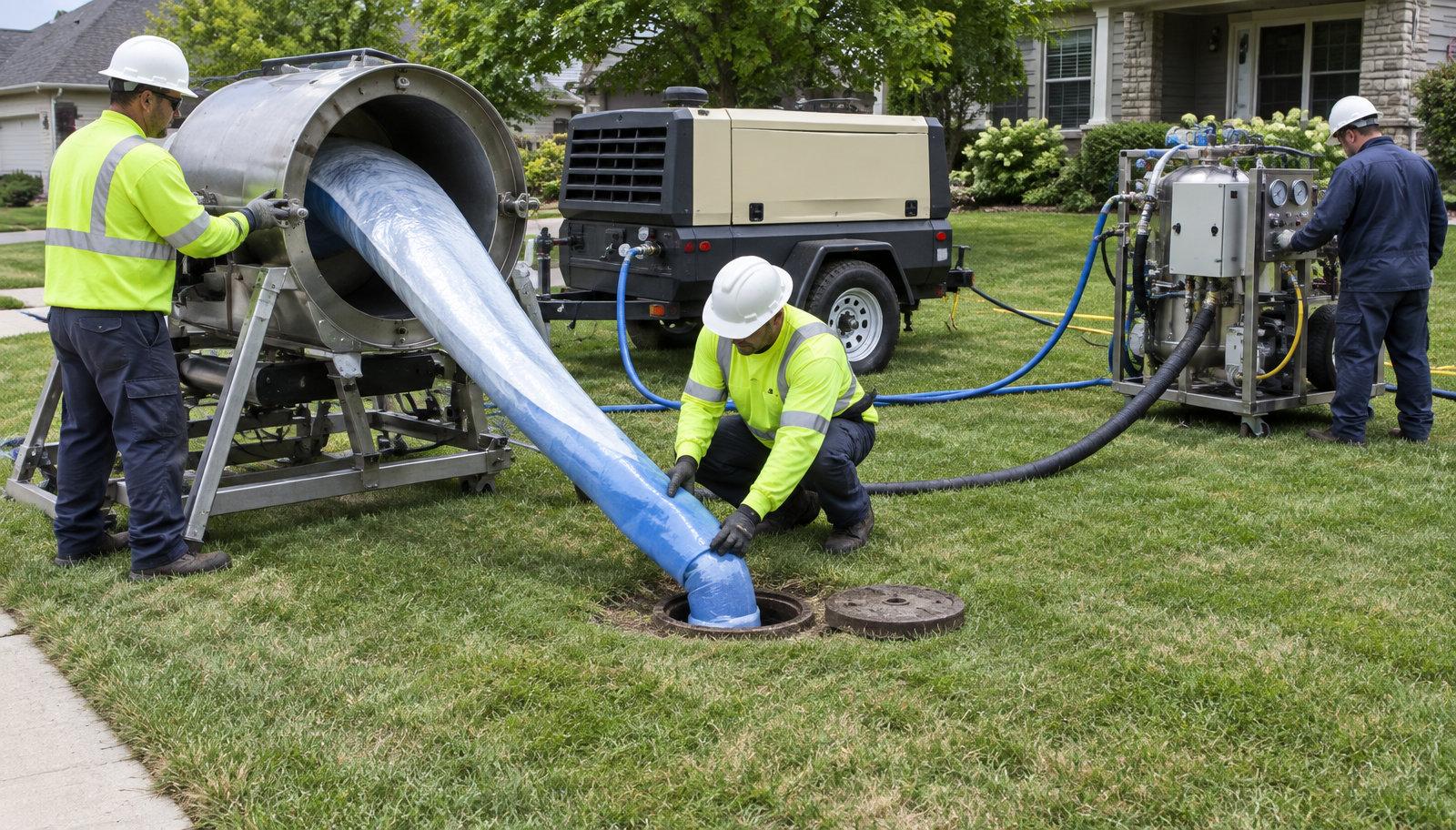
Cured-in-Place Pipe (CIPP): How Lining Works
Cured-in-place pipe, or CIPP, repairs a damaged pipe by building a new one inside it. A flexible tube soaked in resin is put into the old pipe, pressed against its walls and hardened in place. The Florida Department of Health describes the result as a "jointless, seamless" liner fitted inside an existing sewer, water or other pipe (Florida DOH).
For a homeowner, the appeal is simple: a cracked or root-filled sewer line can often be renewed through a cleanout, without a trench across the yard, driveway or floor.
What problems CIPP fixes
- Cracks and holes that let groundwater in and sewage out.
- Root intrusion at joints and cracks; see tree roots in sewer lines.
- Leaking or separated joints, because the liner runs past them as one continuous pipe.
- Corrosion and scale in cast iron, once the pipe has been cleaned back to sound wall.
The Florida DOH sums up the purpose: closing the cracks and holes that let rainwater and roots in and cause stoppages and overflows.
How a lining job works
- Camera inspection. A sewer camera records the line's size, material, defects, bends and branch connections. It decides whether lining is possible at all.
- Cleaning. Roots, grease and scale are removed, usually by hydro jetting or mechanical cutters, so the liner sits against the pipe wall.
- Measuring and wetting out. The liner tube is cut to length and saturated with resin, either at the shop or on site.
- Installing the liner. The tube goes in by one of two methods (below) and is inflated against the old pipe.
- Curing. Hot water, steam or ultraviolet light hardens the resin into a rigid pipe.
- Reopening connections and checking. Branch lines covered by the liner are cut open from inside, the ends are finished, and a second camera run shows the result.
Inversion and pull-in-place
There are two ways to get the liner into the pipe, each with its own ASTM standard practice:
- Inversion (ASTM F1216): water or air pressure turns the resin-soaked tube inside out as it travels down the pipe, so the resin side ends up against the old wall. It often works from a single access point.
- Pull-in-place (ASTM F1743): the tube is winched into position, then inflated with a calibration hose or bladder so it presses against the pipe.
The method matters less to you than the result. Ask your contractor which one they use and which standard their work follows.
Resins and curing
The Florida DOH lists the resins most used today: styrene-based polyester, styrene-based vinyl ester, styrene-free vinyl ester and epoxy. Which one a contractor uses depends on the pipe, the liner system and how it will be cured: hot water, steam or UV light.
Odors and air quality
Curing can release chemicals into the air. NIOSH, the federal workplace safety institute, names styrene as the main chemical hazard for CIPP workers and recommends well-ventilated work areas and, where possible, non-styrene resins (NIOSH). The Florida DOH adds bagging leftover liner right away, and notes that odors can reach nearby buildings through plumbing, open windows and doors. If a job is planned at your home, ask which resin will be used, how the crew will ventilate, and whether you should keep drains capped or windows closed during curing. If you notice strong odors and feel unwell near a job, leave the area and report it to your local health department.
When CIPP is a good fit
- The pipe is cracked, leaking or rooted but still holds its shape.
- The line runs under something costly to dig up: a slab, driveway, patio or mature trees.
- The pipe has bends or changes in material along its run; liners follow the existing path.
- You want to keep the current route and connections rather than build a new line.
When it is not
- Collapsed or flattened sections. The liner takes the shape of the pipe it's in. A broken or deformed line usually needs pipe bursting or a short excavation first.
- Sags (bellies). Lining follows the sag rather than correcting it; see bellied pipes.
- Severe offsets where the pipe sections no longer line up.
- A line that needs to be larger. A liner slightly reduces the inside diameter; bursting can upsize.
- One isolated defect. A short sectional liner or spot repair may be all that's needed.
Fiber pipe is a common special case: see our guide to Orangeburg pipe.
CIPP vs pipe bursting
| CIPP lining | Pipe bursting | |
|---|---|---|
| What it does | Builds a new pipe inside the old one | Breaks the old pipe and pulls in a new one |
| Old pipe condition | Must still hold its shape | Can be broken, if the cable passes |
| Pipe size afterward | Slightly smaller | Same or larger |
| Digging | Often none, through a cleanout | A pit at each end |
| Branch connections | Reopened from inside | Dug up and reconnected |
For a step-by-step way to choose, see choosing a repair method.
How a lining job is checked
The final camera run is your best evidence. It should show a smooth liner without wrinkles that block flow, ends finished cleanly, and every branch connection reopened. The Florida DOH notes that samples of new liners are often collected and tested for strength as a condition of installation. On a home job, ask for the before and after videos and for the liner and resin specifications in writing.
What it costs
Angi lists CIPP lining at $80–$250 per foot nationally (Angi, updated July 9, 2026). Line length, pipe size, cleaning needed, the number of connections to reopen and access move a job within that range. All published ranges, with sources, are in our cost comparison guide.
Questions to ask a contractor
- Does the inspection video show a pipe that can be lined, and can I keep it?
- How will you clean the line first?
- Inversion or pull-in-place, and which ASTM standard does your work follow?
- Which resin will you use, how will it be cured, and how will you handle odors?
- How many connections will you reopen, and how?
- What warranty do you give, on the liner and on the work?
Frequently asked questions
What does cured-in-place pipe mean?
It means the new pipe is formed and hardened ("cured") inside the old one, in place underground, rather than being dug in as a separate pipe.
Can CIPP fix a collapsed pipe?
Not by itself. The liner needs a pipe that still holds its shape. A collapsed section is usually replaced first, by bursting or a short dig, and the rest of the line can then be lined.
Does lining reduce flow?
The inside diameter gets slightly smaller, but the liner is smooth and has no joints, so roots and buildup have fewer places to catch. Ask your contractor how the finished size compares for your line.
Will I need to stop using water during the work?
Yes, for part of it. Drains in the lined section can't be used while the liner is installed and curing. Ask how long the line will be out of service.
How do I find a CIPP contractor near me?
Search our contractor directory for trenchless specialists in your area and filter by CIPP lining.
Sources
- Florida Department of Health: Cured-in-Place Pipe (CIPP) fact sheet (updated June 1, 2023)
- NIOSH: Cured-in-place pipe (reviewed September 20, 2023)
- ASTM F1216 (inversion) and ASTM F1743 (pull-in-place), standard practices for cured-in-place pipe rehabilitation
- Angi: sewer line repair and replacement cost (updated July 9, 2026)