

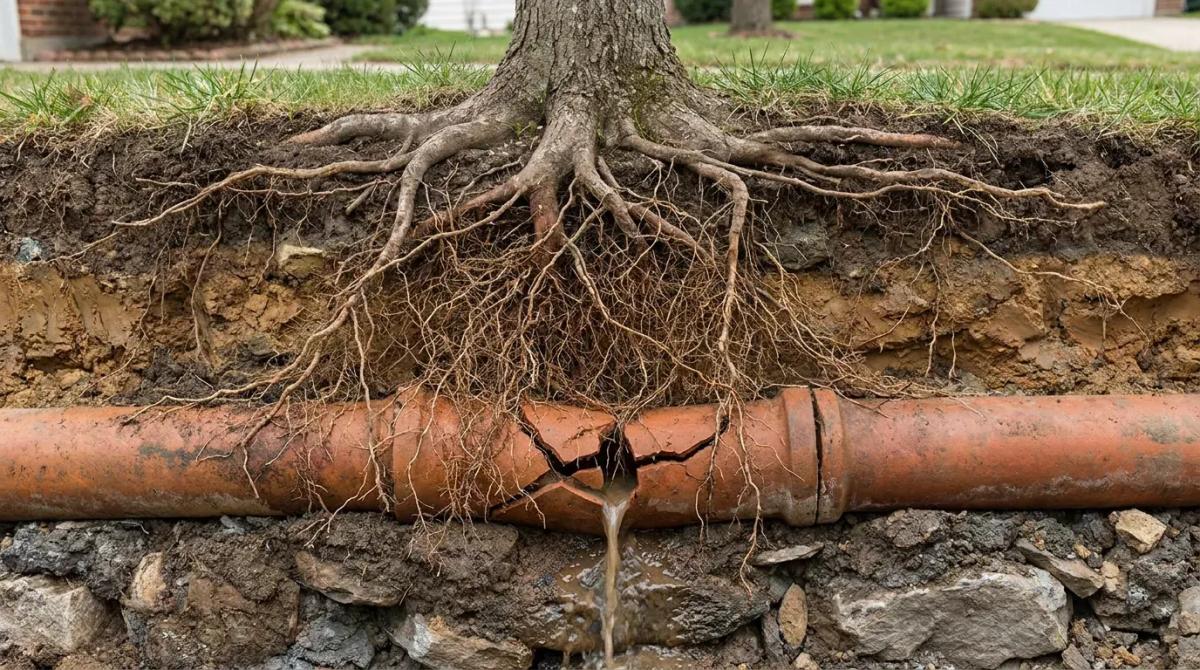
If a plumber has pulled roots out of your sewer line, you have three ways forward: keep cutting them out, treat the line to slow them down, or fix the openings they come through. The first two are maintenance. Only the third ends the problem. Which one makes sense depends on how often the line backs up, what the camera shows, and the tree.
Why roots keep coming back
Roots don't break into a sound pipe. They follow moisture. The City of Traverse City, Michigan explains that roots are "attracted to the water vapor leaving the pipe" and follow it to its source, "usually cracks or loose joints in the sewer pipe" (City of Traverse City). Once inside, fine roots feed on what flows past and grow into a mat that catches paper and waste.
Cutting the roots clears the pipe but leaves the opening. The roots on the outside are untouched, so new growth comes back through the same gap. That is why a line that was cleared in spring is often slow again by the next growing season.
Older lines are the most exposed. Traverse City notes that clay tile pipe "was easily penetrated and damaged by tree roots", while PVC is more resistant "because it usually has fewer joints." Every joint in a clay or cast iron line is a possible way in.
Option 1: Cut them out
Mechanical cleaning removes the roots with augers, root saws or high-pressure water jetting. It restores flow the same day, and it is the right first step in a backup.
- Good for: getting the line working again, and preparing it for a camera inspection or a repair.
- Limits: the roots grow back, so the cost repeats. Aggressive cutting can also damage an old, fragile pipe.
- Cost: Angi puts hydro jetting at an average of about $475, with most jobs between $350 and $600 (Angi, updated October 23, 2026).
Option 2: Treat the line
Root treatments, often based on copper sulfate or other herbicides, are flushed or foamed into the line to kill the roots inside the pipe and slow regrowth. They are pesticides, so the label is the law: use only a product made for sewer lines, follow the directions exactly, and ask your sewer utility first, because some states and utilities restrict root killers in the sewer system.
- Good for: stretching the time between cleanings on a line you plan to fix later.
- Limits: treatment doesn't close the opening either, and dead roots still have to be cleared.
Option 3: Fix the openings
To end the problem, the gaps have to be sealed or the pipe replaced. A camera inspection after cleaning shows how many entry points there are and what shape the pipe is in.
| What the camera shows | Usual fix |
|---|---|
| Roots at one or two joints in a sound pipe | Spot repair: a short liner over each joint |
| Roots at many joints along the line | CIPP lining of the whole run, which leaves no joints to get through |
| Roots through a broken or collapsed section | Pipe bursting or a short excavation for that section |
| Roots plus a sag where water sits | Excavation to reset the grade; a liner would keep the low spot |
Angi lists CIPP lining at $80–$250 per foot nationally (Angi, updated July 9, 2026). A lined pipe is one continuous tube, so roots have no joint left to follow.
When to stop cutting and fix it
There is no single rule, but the math usually turns after a few cleanings. Compare what you spend on clearing the line over a few years with the one-time cost of a repair, and add what each backup costs you in cleanup and disruption. Fixing it sooner makes sense when:
- the line needs clearing more than once a year,
- you have had a backup into the house,
- the camera shows cracks or broken pipe around the roots,
- you plan to sell, and the buyer's inspection will find it anyway,
- the line runs under a driveway, patio or slab you don't want dug up later.
What about the tree?
Removing a healthy tree is rarely necessary, and it doesn't fix the pipe: the opening stays, and roots from other trees and shrubs can find it. Sealing the pipe protects both. When you plant, keep trees and large shrubs away from the sewer route; Traverse City advises owners to "refrain from planting certain types of trees and hedges near sewer lines." Knowing where your line runs, from a locate or the camera, makes that easier.
If the roots come from a street tree or a neighbor's tree, talk to the owner or the city before you cut or remove anything. Who pays for what is set locally.
Questions to ask a contractor
- Can I see the camera video after the roots are cleared?
- How many entry points are there, and is the pipe cracked or broken around them?
- Would spot repairs be enough, or does the whole line need lining?
- If you recommend a root treatment, which product, and is it allowed by our sewer utility?
- What warranty comes with the repair?
Frequently asked questions
How do I know roots are the problem?
Slow drains across the house, gurgling toilets and backups that return months after cleaning are typical. A cable that comes back with roots on it, or a camera inspection, confirms it.
Will cutting the roots damage my pipe?
It can, on old clay or cast iron that is already cracked. Ask the contractor to match the tool to the pipe and to show you the video afterward.
Can roots get into a lined pipe?
Not through the lined section, because it has no joints. The ends and branch connections are where to look on later inspections.
Should I cut down the tree?
Usually no. Fix the openings in the pipe and keep the tree. Plan new plantings away from the sewer route.
Sources
- City of Traverse City, Michigan: Tree roots vs sewer lines
- Angi: hydro jetting cost (updated October 23, 2026)
- Angi: sewer line repair and replacement cost (updated July 9, 2026)