

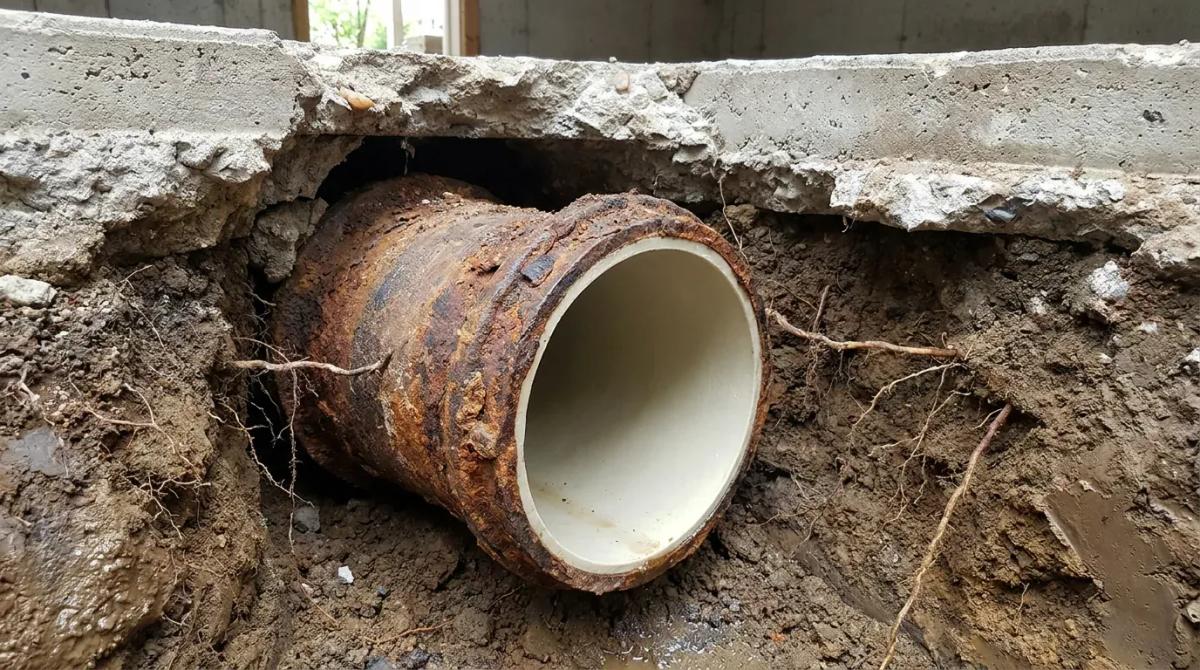
If your house has cast iron drains and a plumber has found cracks, heavy rust or a slow line that keeps clogging, you will probably hear two proposals: tear it out and replace it, or line it from the inside. Both can be the right answer. Which one fits depends on where the pipe runs, how much wall is left, and how many bends and branches it has.
Why cast iron drains wear out
Cast iron was used for drainage pipe through much of the 20th century (Wikipedia). It is strong and quiet, but it corrodes from the inside. Rust builds up in layers called tubercles that narrow the pipe, and acid-forming gases from sewage attack the top of horizontal runs. Over time the wall thins until it cracks, splits along its length or rusts through. The bottom of long horizontal pipes can also wear into a groove, a failure plumbers call channeling.
The warning signs are familiar: drains that slow down across the house, clogs that come back soon after cleaning, rust flakes on a plumber's cable, sewer odor, or damp spots near a stack or along a slab.
Where the pipe runs matters most
Lining is most attractive where replacement means demolition:
- Under a slab. Replacing a buried drain under a house on a slab means breaking up floors, often in kitchens and bathrooms. Lining works from cleanouts and a few small openings.
- Inside walls and ceilings. Vertical stacks and branch lines in finished rooms can be lined from roof vents and cleanouts instead of opening walls floor by floor.
- The yard lateral. Outside the house the choice is closer to any other sewer line: lining, pipe bursting or digging, depending on condition and what sits on top.
Where a pipe is exposed, in a basement or crawl space, replacing that section is usually simple and the case for lining is weaker.
What lining can and can't do
Cured-in-place pipe lining puts a resin-soaked tube inside the old pipe and hardens it into a new pipe; see our CIPP lining guide. In cast iron it can:
- seal cracks, holes and leaking joints along a run,
- stop roots and groundwater from getting in,
- give a smooth inside surface where rust and scale used to catch waste.
It can't fix everything:
- Missing or collapsed sections. A liner needs something to hold its shape. A section that has rusted away or caved in is usually replaced first.
- Sags and bad slope. A liner follows the pipe. If a line under a slab has settled, lining keeps the low spot; see bellied pipes.
- Tight fittings. Liners can wrinkle at sharp bends. Charlotte Pipe, a cast iron and plastic pipe manufacturer, calls the liner "susceptible to wrinkling and deforming" around corners and says it explicitly recommends replacing broken, damaged or leaking cast iron pipe and fittings (Charlotte Pipe, June 27, 2025). Lining contractors use liners and methods made for bends and branches; the camera video shows whether your fittings are a problem.
- Pipe size. A liner makes the inside diameter a little smaller. On small drains, ask how much.
Lining, coating or replacing
| Option | What it is | Fits when |
|---|---|---|
| CIPP lining | A new pipe formed inside the old one | The pipe is cracked or leaking but still holds its shape, and replacement means opening floors or walls |
| Epoxy coating | A sprayed or brushed layer on the inside wall | The pipe is sound and needs protection from further corrosion, not structural repair |
| Spot repair | A short liner over one defect | The rest of the line is in good shape |
| Replacement | Cutting out the cast iron and installing new pipe | Sections are missing, collapsed or badly sagged, or the pipe is easy to reach |
Many jobs combine them: a damaged section is replaced and the rest of the run is lined.
Reading the camera video
A camera inspection decides the repair, but cast iron needs two looks. Heavy scale hides the wall, so the pipe is descaled first and inspected again. In the second video, look for:
- Daylight or soil through the wall: a hole, not just a crack.
- A groove along the bottom of horizontal pipe: channeling, which may need the bottom rebuilt before lining.
- Standing water that won't drain: a sag.
- Every branch and fitting along the run, since each one has to be reinstated or handled after lining.
Ask for both videos and keep them. They show what you paid to fix.
Lining inside an occupied home
When lining is done inside a house, the curing step matters. The Florida Department of Health notes that chemicals from CIPP work can reach nearby buildings through plumbing, open windows and doors, and lists styrene-free resins such as epoxy among the options (Florida DOH). NIOSH, the federal workplace safety institute, names styrene as the main chemical hazard for CIPP workers and recommends good ventilation (NIOSH). Ask which resin will be used, how the work area will be ventilated, and how long you'll be without drains.
What it costs
Price depends on how many feet are lined, how many branches must be reopened, how much descaling the pipe needs and how hard it is to reach. Angi lists CIPP lining of sewer lines at $80–$250 per foot nationally (Angi, updated July 9, 2026); in-home drain work with many fittings is priced job by job. Compare that with the full cost of replacement, including the floors, tile, cabinets or walls that would have to be opened and restored. Our cost comparison guide has the published ranges.
Questions to ask before you choose
- Can I see the video after descaling, not just before?
- Which sections would you replace, and which would you line?
- How will you handle the bends and branch connections on this run?
- What resin will you use, and how will you ventilate the house during curing?
- How much smaller will the pipe be after lining?
- What warranty do you give, and does it cover the liner, the work or both?
Ask a second contractor the same questions. If one recommends lining and another replacement, the video should show you why.
Frequently asked questions
Can cast iron pipe be lined?
Often, yes, if it still holds its shape after cleaning. Missing, collapsed or badly sagged sections are replaced first.
Is lining better than replacing cast iron?
Neither is better in every case. Lining avoids opening floors and walls; replacement removes the old pipe for good and is often simpler where the pipe is easy to reach. The camera video and the pipe's location decide.
Does lining stop cast iron from rusting?
The liner separates the old wall from the waste flowing through it, so the inside no longer catches debris. It does not restore the old pipe; the liner itself carries the flow.
Should I worry about cast iron when buying an older home?
Ask for a sewer camera inspection before closing. It is a small cost next to a slab repair, and it tells you what condition the drains are in.
Sources
- Wikipedia: Cast iron pipe
- Charlotte Pipe: Examining the consequences of cured-in-place pipe lining (June 27, 2025)
- Florida Department of Health: Cured-in-Place Pipe (CIPP) fact sheet (updated June 1, 2023)
- NIOSH: Cured-in-place pipe (reviewed September 20, 2023)
- Angi: sewer line repair and replacement cost (updated July 9, 2026)