

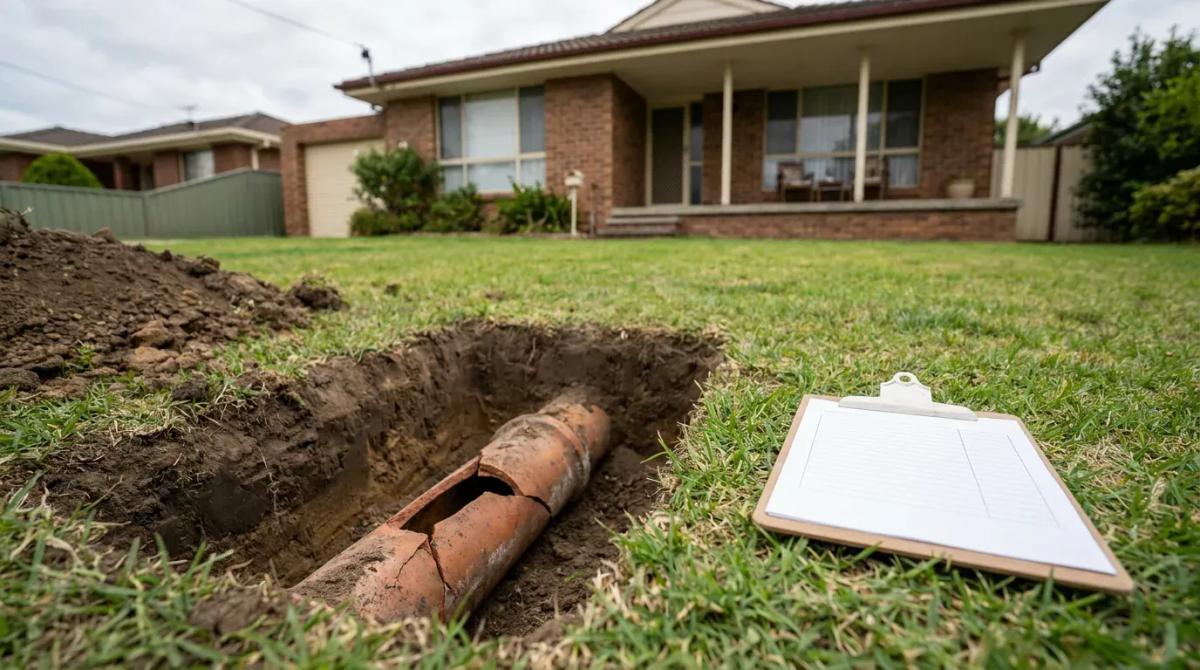
Short answer: a standard homeowners policy usually doesn't pay to fix a worn, cracked or root-filled sewer line, and it usually doesn't cover the mess when sewage backs up into the house either. Both can often be added for an extra premium, as separate endorsements. This post explains the difference, what each one tends to cover, and what to check before you need it.
Three different things people call "sewer coverage"
| What it is | What it's for | Where it comes from |
|---|---|---|
| Service line (buried utility line) endorsement | Repairing or replacing the broken pipe itself, including digging | An add-on to your homeowners policy |
| Sewer or water backup endorsement | Damage inside the home when sewage or water backs up through drains | An add-on to your homeowners policy |
| Line warranty or "protection plan" | Repairs to the line under the plan's terms | A service contract, often sold by mail or through a utility bill |
They are easy to confuse, and having one doesn't mean you have the others.
What a standard policy leaves out
On backups, the Minnesota Department of Commerce is direct: "Neither flood insurance nor a typical homeowner's insurance policy will cover damage caused by sewer back-ups." It adds that to get that coverage, "homeowners must purchase a separate product or endorsement," and that the endorsement "varies from company to company" (Minnesota Department of Commerce).
The pipe itself is a separate question. The most common reasons a sewer line fails, such as age, corrosion, roots and settling, are the kind of wear a standard policy generally isn't written to pay for. That is the gap a service line endorsement is meant to fill. Read your own policy's exclusions to see how yours is worded.
What a service line endorsement can cover
Progressive describes service line coverage, also called buried utility lines coverage, as an endorsement that can be added to many home policies to cover repairing or replacing a broken utility line running into the home. According to its explainer (Progressive, updated August 15, 2023):
- Lines: it can include the main sewer line from the home to the street, along with water, gas, electric and cable lines.
- Causes: it may cover rust, corrosion, deterioration and wear and tear, freezing, and trees and roots.
- Costs: it may pay for the repair or replacement, the excavation, and landscaping damaged by the work.
- Limits: the limit is often up to $10,000, a deductible may apply, and the endorsement raises your premium.
- Usually not covered: septic systems, fuel tanks and lines not yet connected for use.
That is one insurer's description. Other companies' endorsements use different limits, deductibles and wording, and not every insurer offers one, so ask for the actual endorsement form before you rely on it.
Sewer backup coverage is for what's inside
A backup endorsement pays toward damage in the home: flooring, walls, belongings and cleanup when sewage or water comes up through a floor drain or toilet. It generally doesn't pay to fix the pipe that caused it. Minnesota Commerce also notes that some companies exclude backup coverage if it happens at the same time as a flood, so check how your policy treats that.
If your basement has a floor drain or plumbing fixtures, this is the endorsement to ask about first. A backup can do more damage to finished space than the pipe repair costs.
Line warranties and protection plans
Many homeowners get letters offering sewer or water line "protection" for a monthly fee. These are usually service contracts, not insurance, and the company sending them is often not your utility, even when the letter looks official. Before you sign up:
- Check whether your sewer utility actually partners with the company.
- Read the per-repair limit, what parts of the line are included, and whether roots, sags or "pre-existing conditions" are excluded.
- Compare it with the cost of adding a service line endorsement to the policy you already have.
What a repair can cost without coverage
Angi lists trenchless sewer repair at about $60–$250 per foot nationally, CIPP lining at $80–$250 per foot and pipe bursting at $60–$200 per foot (Angi, updated July 9, 2026). A camera inspection averages about $995 according to HomeAdvisor (HomeAdvisor, updated June 19, 2026). Compare those with an endorsement's limit and deductible. Our posts on sewer line replacement cost and camera inspection cost go into what drives the price.
If you need to file a claim
- Call your insurer early and ask whether you have service line or backup coverage, and what they need from you.
- Document everything: photos of any damage inside, and the receipts for cleanup.
- Get the line filmed. A camera inspection shows what failed and where, which is what an adjuster will ask about.
- Find out where your part of the line ends. If the break is on the utility's side, it may be theirs to fix; see sewer lateral repair.
- Get a written quote that names the method and the length of pipe. Ask the insurer whether they cover lining or bursting the same way as digging.
Questions to ask your insurance agent
- Do I have a service line (buried utility line) endorsement? What is the limit and the deductible?
- Does it cover wear and tear, roots and corrosion on the sewer line?
- Does it pay for excavation and restoring the yard or driveway?
- Do I have sewer or water backup coverage, and what is its limit?
- Is backup excluded if it happens during a flood?
Frequently asked questions
Will homeowners insurance pay to replace an old sewer line?
Usually not under a standard policy, because age and wear are the common causes. A service line endorsement, if you have one, may pay up to its limit.
Are tree roots in the sewer line covered?
Not usually by a standard policy. Some service line endorsements list trees and roots as a covered cause; check yours.
Does flood insurance cover a sewer backup?
Minnesota Commerce says neither flood insurance nor a typical homeowners policy covers sewer backups; a backup endorsement is the usual route.
Can I add coverage after I find a problem?
Coverage applies to losses after it starts, and insurers may exclude problems that already exist. Add it before you need it.
Need a camera inspection or a repair quote? Find a trenchless contractor who covers your area.
Sources
- Minnesota Department of Commerce: Sewer backup policy
- Progressive: What is service line coverage? (updated August 15, 2023)
- Angi: sewer line repair and replacement cost (updated July 9, 2026)
- HomeAdvisor: sewer line camera inspection cost (updated June 19, 2026)