

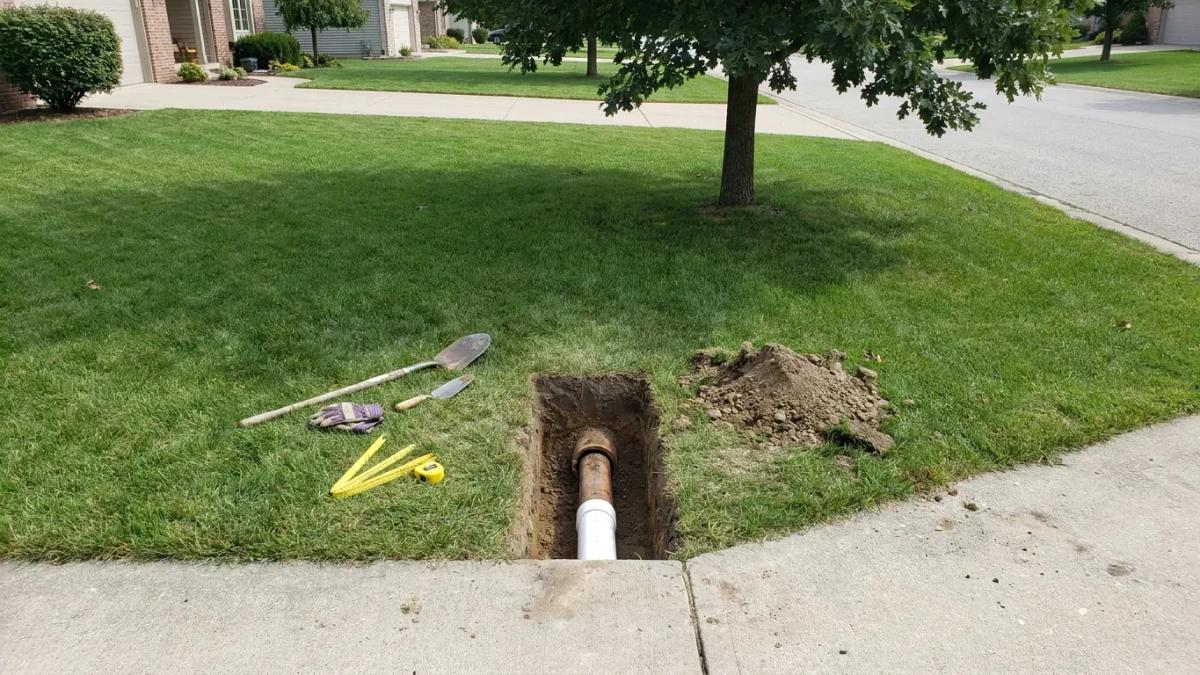
Replacing a sewer line is usually priced by the foot. Angi puts digging and replacing a line at $50–$250 per foot and trenchless replacement at $60–$250 per foot (Angi, updated July 9, 2026). Where your job lands in that range depends on the length and depth of the line, what sits on top of it, and the method that suits the pipe.
Published price ranges
| Work | Published range | Source |
|---|---|---|
| Dig and replace the line | $50–$250 per foot | Angi, July 9, 2026 |
| Traditional excavation | $50–$200 per foot | This Old House, March 30, 2026 |
| Trenchless replacement (any method) | $60–$250 per foot | Angi; This Old House |
| Cured-in-place (CIPP) lining | $80–$250 per foot | Angi |
| Pipe bursting | $60–$200 per foot | Angi |
| Trenching alone | $4–$12 per foot | Angi |
| Sewer camera inspection | $271–$1,725; average about $995 | HomeAdvisor, June 19, 2026 |
These are national ranges. Local labor rates, permit fees and soil conditions move real quotes up or down. For repair (not replacement) costs and the other trenchless services, see our cost comparison guide.
How to estimate your own line
Start with the length: the run from the cleanout at your house to the connection at the street or main. A camera inspection report usually gives it. Multiply that length by the per-foot range for the method that fits your pipe.
For example, a 60-foot lateral at Angi's trenchless range of $60–$250 per foot works out to roughly $3,600–$15,000 before the extras below. The wide spread is normal: it reflects depth, access and how much has to be restored, which the next section covers.
What drives the price
- Length and depth. Longer and deeper lines need more pipe, more labor and, if dug, bigger trenches.
- What sits on top. Lawn is cheap to restore; a driveway, patio, slab or mature trees are not. This is where trenchless methods save the most.
- The method that fits. Lining needs a pipe that still holds its shape; pipe bursting replaces a broken one and can upsize it. The camera decides which applies.
- Pipe condition. A collapsed section, roots throughout or a deep sag can add excavation to an otherwise trenchless job.
- The connection at the street. Work in the street or sidewalk often means permits, traffic control and city inspection.
- Timing. An emergency call during a backup leaves less room to compare quotes than a planned job.
Digging vs trenchless
The per-foot ranges overlap, so the method alone rarely decides the price. What differs is the restoration. A dig-and-replace job opens a trench along the whole line, and everything in its path has to be rebuilt. A trenchless job disturbs the ground only at one or two access points. On a line under a driveway or mature landscaping, that difference usually outweighs the per-foot price. Our trenchless vs traditional cost guide walks through the comparison.
Costs that are easy to miss
- Inspection. A camera inspection is the first cost on most jobs; some contractors credit it against the repair.
- Permits. Fees vary by city. Ask who pulls the permit and whether it is in the quote.
- Restoration. Check whether replacing concrete, pavers or sod is included or billed separately.
- A cleanout. If the house has no accessible cleanout, adding one may be part of the job.
- The part under the street. Who pays for the section nearest the main depends on the city. In Jefferson Parish, Louisiana, for example, the parish's responsibility starts at the cleanout near the sidewalk, and the line from there to the house is the owner's (Jefferson Parish). Ask your sewer utility where your part ends.
Does insurance pay for it?
Read your policy before assuming it does. Standard homeowners coverage often treats a line that failed from age, wear or roots as maintenance. Some insurers and utilities offer separate service line coverage, and sewer backup coverage is usually its own endorsement. Ask your agent what is covered for the pipe itself versus water damage inside the house.
Getting quotes you can compare
- Get a camera inspection and keep the video. Share the same video with every contractor you ask.
- Ask each to quote the same scope: method, length, pipe size and material, number of pits, restoration and permits.
- Ask what happens if they find more damage once work starts, and how that would be priced.
- Compare warranties on the work and on the pipe or liner.
Find trenchless contractors near you in our contractor directory.
Ways to keep the cost down
- Fix only what is broken. If the camera shows one or two defects in an otherwise sound line, a spot repair costs far less than replacing the whole run.
- Act on early signs. Recurring slow drains and root clogs get more expensive once a pipe collapses.
- Know your pipe. Homes built from the late 1940s to the early 1970s may have fiber Orangeburg pipe, which usually needs replacing rather than lining.
- Plan around other work. If the driveway or street is being redone anyway, replacing the line at the same time can save restoration costs.
Frequently asked questions
How much does it cost to replace a sewer line?
Published national ranges are $50–$250 per foot to dig and replace and $60–$250 per foot for trenchless replacement (Angi). Multiply by your line's length, then add inspection, permits and restoration.
Is trenchless replacement cheaper than digging?
Not always per foot, since the ranges overlap. It often costs less overall when the line runs under a driveway, patio, slab or mature trees, because there is much less to restore.
Should I repair or replace my sewer line?
It depends on how much of the line is damaged. See our guide to repairing vs replacing a sewer line.
Sources
- Angi: sewer line repair and replacement cost (updated July 9, 2026)
- This Old House: sewer line replacement cost (updated March 30, 2026)
- HomeAdvisor: sewer line inspection cost (updated June 19, 2026)
- Jefferson Parish: sewerage FAQ