
When a sewer line clogs, most plumbers reach for one of two tools: a snake (a drain auger or cable machine) or a hydro jetter. Both clear the line. They work differently, cost different amounts, and suit different problems. Here is how to tell which one your line needs, and why neither one is the whole answer when the pipe itself is damaged.
How each one works
Snaking
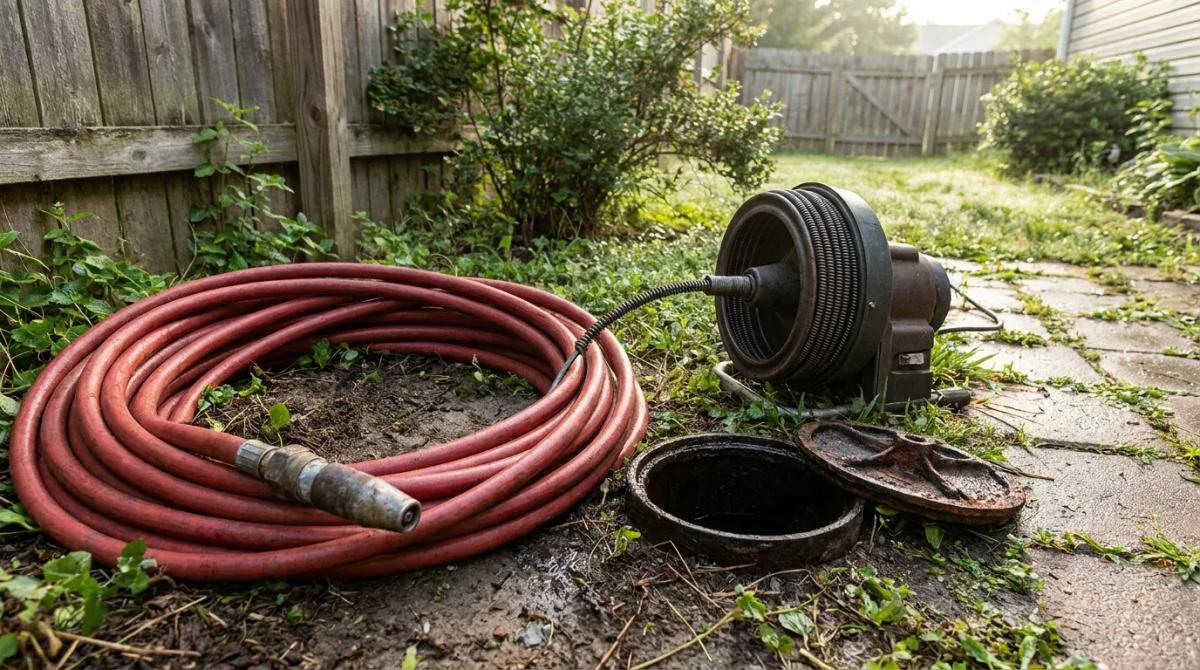
A snake is a flexible steel cable turned by a motor, with a cutting head or auger on the end. It is fed into the line through a cleanout or drain until it reaches the clog, then it bores through it or pulls it back. It opens a path for water to flow, which is often all a simple clog needs.
Hydro jetting
A jetter sends high-pressure water through a hose with a nozzle that sprays forward to cut through a blockage and backward to pull the hose along and scour the pipe walls. Instead of punching a hole through a clog, it washes grease, sludge, scale and fine roots off the inside of the pipe and flushes them downstream.
Side by side
| Snaking | Hydro jetting | |
|---|---|---|
| Best for | A single clog: paper, wipes, a small obstruction | Grease and sludge buildup, scale, fine root growth, lines that clog again and again |
| What it leaves | A path through the clog; buildup on the walls stays | Cleaner pipe walls along the run |
| Roots | Cuts a path; roots grow back | Clears fine roots more thoroughly; roots still grow back through open joints |
| Fragile or broken pipe | Lower risk, but a cutter can still catch on broken pipe | Needs care: a contractor should check the pipe's condition first |
| Typical national cost | About $100–$400 for a sewer main line | About $350–$600, average about $475, up to about $2,000 for hard jobs |
Costs are from Angi, which puts hydro jetting at an average of $475, with most homeowners paying $350 to $600 and complex jobs reaching about $2,000, and snaking a sewer main line at $100 to $400 (Angi, updated October 23, 2026). Your price depends on the clog, access and the length of the line.
Which one does your line need?
- One clog, first time: snaking is usually enough and costs less.
- Grease or kitchen-line buildup: jetting removes it from the walls instead of just poking through it.
- Clogs that keep coming back: something is catching waste, such as roots, a sag, scale or a broken joint. Clear it, then find out what it is.
- Before a camera inspection or a liner: the line has to be clean so the camera can see and the liner can bond. The EPA's guide for sewer utilities makes the same point about inspections: cleaning "should always be considered before inspection is performed" (EPA CMOM guide).
Why neither one fixes a damaged pipe
Snaking and jetting are cleaning, not repair. If roots got in through an open joint, they grow back through the same joint; the City of Traverse City, Michigan notes that roots follow water vapor to "cracks or loose joints in the sewer pipe" (City of Traverse City). A sag still holds water after it is cleaned, and a broken section is still broken.
That is why the most useful thing after a clog is cleared is a camera inspection. If it shows damage, the repair options are:
- Spot repair for one or two bad joints.
- CIPP lining for cracks or root entry along the line.
- Pipe bursting or excavation for broken or collapsed pipe.
If you are paying for cleaning more than once a year, compare that with the one-time cost of a repair. The tree roots and replacement cost posts walk through that decision.
Doing it yourself
A hand auger can clear a sink or tub. A sewer main is a different job: rental machines are heavy, the cable can kink or whip, and it is easy to hit a break you can't see. Jetting at sewer pressure is a job for a trained contractor. If the clog is in the main line and you don't know the pipe's condition, hire it out.
Questions to ask before you book
- Will you snake or jet, and why for this line?
- What is the pipe made of, and is it safe to jet?
- Is a camera inspection included, or can you add one after clearing?
- If you find damage, will you show me the video before quoting a repair?
Frequently asked questions
Is hydro jetting better than snaking?
Not always. Jetting cleans more thoroughly, so it suits grease, scale and recurring clogs. For a single simple clog, snaking does the job for less.
Can hydro jetting damage my pipes?
It can make a weak spot worse in an old or broken pipe, which is why a careful contractor checks the line first, often with a camera.
How often should a sewer line be cleaned?
A healthy line shouldn't need regular cleaning. If yours does, something is causing it, and a camera inspection will show what.
Will jetting get rid of tree roots for good?
No. It clears them, but they grow back through the same joints. Sealing those joints with a liner or spot repair ends the problem.
Need a line cleared, filmed or repaired? Find a trenchless contractor who covers your area.