

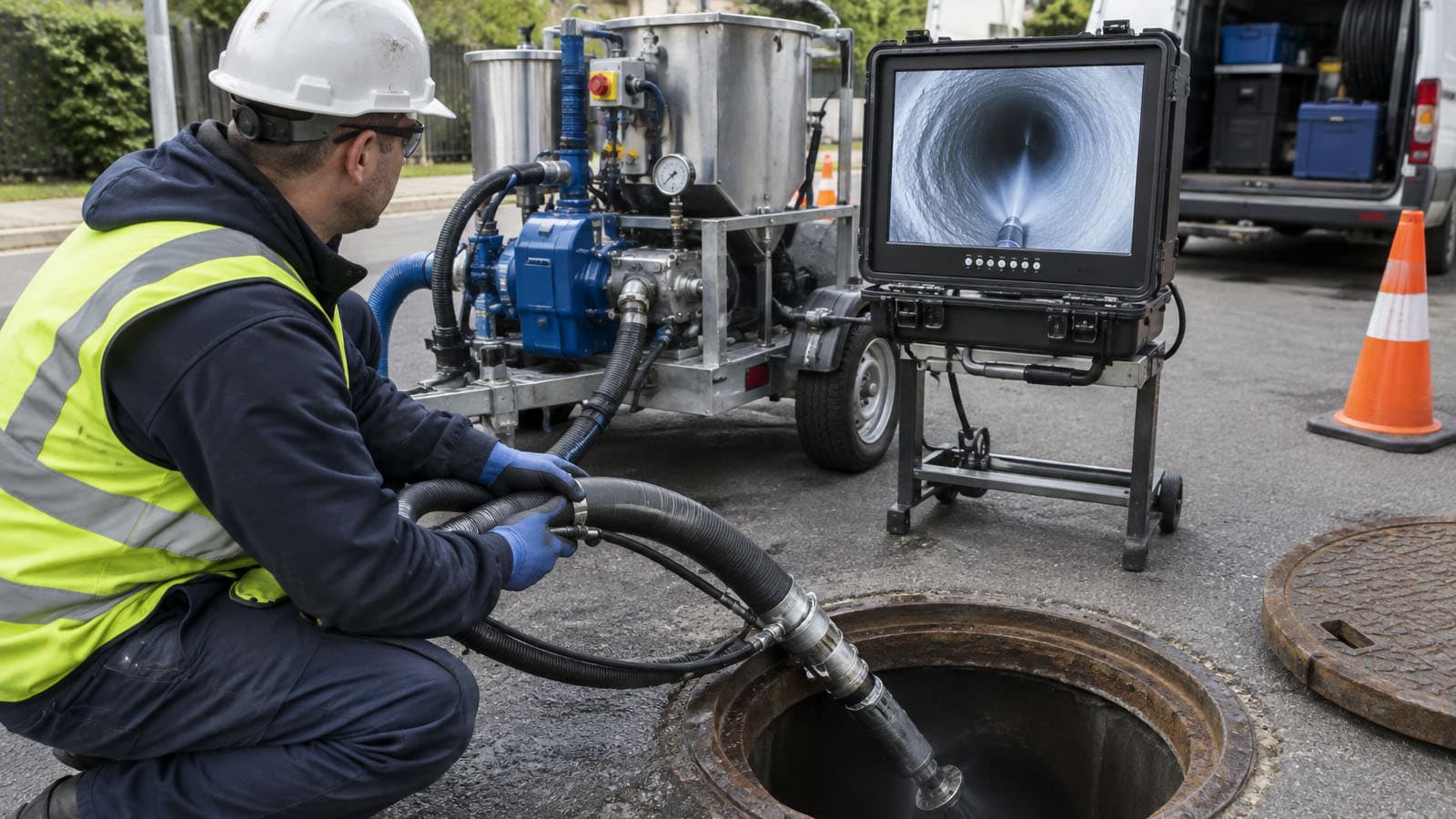
Spray Lining Technology: Fast Protective Coating Method

🤖 200-500+ Feet Per Day
Robotic precision • 3-5x faster than manual • Uniform protective coating
Spray lining technology delivers protective pipe coatings through robotic equipment that applies uniform epoxy or polymer layers to pipe interiors at production rates far exceeding manual application methods. The technology uses centrifugal or airless spray systems mounted on remotely-controlled platforms, building coatings layer-by-layer to specified thicknesses while maintaining exceptional uniformity impossible through brush or roll application. This mechanized precision enables 200-500+ linear feet of coating per day—dramatically faster than traditional coating approaches.
The speed and coating uniformity advantages define spray lining's niche within trenchless methods. Where manual pipe coating methods might complete 50-100 feet daily with variable thickness, robotic spray systems deliver consistent 20-80 mil coatings across hundreds of feet. The mechanized application eliminates human inconsistency—every section receives identical treatment, creating uniform protection throughout pipe lengths. Production rates justify equipment investments for contractors handling substantial pipe rehabilitation volumes.
⚠️ Critical Limitation: Protection Without Reinforcement
Spray lining shares fundamental limitations with all coating technologies—it provides protection without structural reinforcement. The thin epoxy or polymer barriers (typically 0.5-2mm) prevent corrosion, seal minor imperfections, and protect against chemical attack, but contribute zero load-carrying capacity. Pipes requiring structural rehabilitation need CIPP structural rehabilitation or replacement rather than protective coating alone.
Understanding Spray Lining Technology
Spray lining employs robotic platforms equipped with rotating spray heads that traverse pipe interiors, applying epoxy or polymer coatings through centrifugal force or high-pressure airless systems. The remote-controlled equipment positions spray heads at optimal distances from pipe walls—typically 12-24 inches for centrifugal systems—while material pumps deliver two-component mixtures at controlled rates. As spray heads rotate and advance through pipes, coating layers build uniformly across all surfaces.
Layer-by-Layer Application:
The layer-by-layer application approach distinguishes spray lining from single-application methods. Initial passes establish base adhesion to cleaned pipe surfaces, with subsequent layers building to specified total thickness—typically 20-80 mils (0.5-2mm) depending on protection requirements. Multiple thin layers create better adhesion and more uniform coverage than attempting single thick applications. The robotic equipment maintains consistent speed, rotation, and material flow throughout application, eliminating the thickness variations manual application introduces.
Real-Time Quality Control:
Real-time monitoring during application verifies coating uniformity and identifies any equipment malfunctions requiring correction. Camera systems allow operators to observe coating coverage, while material flow sensors confirm consistent delivery rates. This process control ensures every pipe section receives specified protection—a quality assurance level difficult achieving through manual coating methods.
Spray Lining (Robotic)
- Speed: 200-500 ft/day
- Uniformity: ±2 mils variation
- Application: Mechanized precision
- Cost: $40-120/ft
- Equipment: $50K-150K investment
- Best for: Large-scale projects
Manual Coating
- Speed: 50-100 ft/day
- Uniformity: Variable thickness
- Application: Brush/roller/manual spray
- Cost: $30-80/ft
- Equipment: Minimal investment
- Best for: Small projects, repairs
Both spray lining and traditional pipe coating methods serve protective rather than structural purposes, creating barriers against corrosion, chemical attack, or infiltration in pipes maintaining adequate structural integrity. However, application methods and resulting coating quality differ substantially between robotic spray systems and manual techniques.
CIPP pipe lining and spray lining address fundamentally different pipe conditions:
CIPP (Structural Rehabilitation):
- Creates structural liners 3-10mm+ thick
- Provides independent load-carrying capacity
- Rehabilitates deteriorated pipes through reinforcement
- Extends service life 50-100 years
- Costs $80-250/ft
Spray Lining (Protective Coating):
- Provides thin coatings 0.5-2mm thick
- Zero structural capacity
- Prevents corrosion and seals porous surfaces
- Extends service life 15-30 years
- Costs $40-120/ft (50-70% less than CIPP)
Technology Selection Critical:
Proper technology selection requires honest assessment of pipe structural condition—choosing spray lining for pipes needing structural repair guarantees continued deterioration and eventual failure. Attempting spray lining on structurally compromised pipes wastes money applying protection to pipes requiring reinforcement.
Types of Spray Lining Systems
Centrifugal spray systems dominate sewer rehabilitation applications through reliable material distribution driven by rotating spray heads operating at 200-600 RPM. The high-speed rotation generates centrifugal force flinging coating materials outward in controlled patterns, creating even distribution without requiring air atomization. This mechanical distribution method proves particularly effective for epoxy and polymer formulations in the viscosity ranges typical for pipe protection applications.
Key Advantages:
- Naturally uniform coatings as equipment traverses
- Overlapping spray patterns ensure complete coverage
- Adjustable rotation speeds and material flow rates
- Mechanical simplicity and proven reliability
- Default choice for municipal and commercial projects
Airless spray systems use high-pressure pumps (1,500-3,000+ PSI) forcing coating materials through precision nozzles, atomizing liquids into fine particles without compressed air. The hydraulic atomization proves effective across broader viscosity ranges than centrifugal methods, handling both thin primers and thicker coating materials. Some contractors prefer airless systems for versatility accommodating different coating formulations within single equipment platforms.
Considerations:
- More sophisticated pressure control required
- Excessive pressure creates overspray and material waste
- Insufficient pressure produces inadequate atomization
- Nozzle wear affects spray patterns (periodic replacement needed)
- Excellent results when properly operated and maintained
Two-component epoxy formulations represent the most common spray lining materials for sewer and water pipe protection. The epoxy resins and hardeners mix immediately before application, with pot life (working time before mixture begins hardening) typically 30-90 minutes depending on formulation and temperature. This limited working time demands efficient application procedures and proper equipment operation avoiding material waste from expired mixtures.
Performance Characteristics:
- Chemical resistance: Suitable for sewer environments
- Adhesion: Strong bond to properly prepared surfaces
- Flexibility: Accommodates minor pipe movement
- Thickness: 20-80 mils (0.5-2mm) typical
- Curing: 4-12 hours depending on conditions

The Spray Lining Process
Comprehensive Inspection:
Comprehensive pipe inspection confirms structural adequacy for coating-only rehabilitation and identifies conditions requiring attention before coating application. The inspection verifies pipes maintain 70%+ structural integrity, documents any cracks or defects beyond coating repair capability, and measures pipe dimensions for equipment selection and material quantity estimation.
Cleaning Requirements:
Cleaning requirements for spray lining exceed normal maintenance standards—coating adhesion demands nearly perfect surface cleanliness. High-pressure water jetting at 2,000-4,000 PSI removes debris, grease, and loose scale. Root cutting addresses any vegetation intrusion. Some projects require mechanical cleaning or even sandblasting for heavily corroded or scaled pipes.
Surface Preparation = 80% of Success:
The cleaned pipe must be dry or only slightly damp (depending on coating material specifications) before application begins, sometimes necessitating air drying or dehumidification in humid climates. Inadequate surface preparation causes coating adhesion failure regardless of application quality.
Equipment Setup:
Robotic spray equipment typically enters pipes through standard manholes or access points, with equipment size selection based on pipe diameter—6 inch minimum typically required for equipment navigation. The remote-controlled platform positions in the pipe section requiring coating, with material hoses connecting to surface-mounted pumps and mixing equipment. Two-component epoxy or polymer materials load into separate reservoirs, mixing inline immediately before delivery to spray heads.
Application Process:
Application proceeds methodically from entry point working toward exit, with spray equipment traversing at controlled speeds (typically 1-5 feet per minute depending on coating thickness requirements and material characteristics). The rotating spray heads maintain consistent distance from pipe walls, applying uniform coating layers as equipment advances. Operators monitor application through camera systems, adjusting parameters if needed to maintain quality.
Most installations require 2-4 passes building coating to specified total thickness, with brief intervals between passes allowing partial curing improving subsequent layer adhesion.
Curing Timeline:
Curing times vary by coating material formulation, ambient temperature, and total coating thickness. Typical epoxy spray linings achieve handling strength within 4-6 hours and full cure within 24-48 hours. Accelerated cure formulations exist for time-critical projects, though often at premium costs. During curing, pipes must remain out of service preventing damage to uncured coatings—bypassing or service interruption planning proves essential.
Quality Verification:
Post-application inspection verifies coating thickness meets specifications throughout pipe length and identifies any defects requiring correction. Hand-held coating thickness gauges confirm material application, while camera inspection documents coating uniformity and coverage.
Service Restoration:
Service restoration occurs once coatings achieve specified cure state, typically same-day or next-day for most projects. The completed spray lining provides immediate protection against corrosion and infiltration, with expected service life 15-30 years depending on service conditions and coating thickness.
Advantages & Limitations
Speed Advantages:
- 200-500 ft/day production rates
- 3-5x faster than manual methods
- Dramatically reduced project timelines
- Minimized service interruptions
- Same-day completion capabilities
- Optimal equipment utilization
Quality Benefits:
- Uniform thickness (±2 mils)
- Eliminates manual inconsistency
- Every surface identical treatment
- Predictable performance
- Extended service life
- Reduced warranty claims
Cost Effectiveness:
At $40-120 per linear foot, spray lining costs 50-70% less than structural rehabilitation methods while providing adequate protection for structurally-sound pipes. The minimal diameter reduction (typically 1-2% from 0.5-2mm coating thickness) preserves flow capacity better than most alternative rehabilitation approaches. For large-diameter pipes or extensive pipe networks requiring protective coating, spray lining's combination of speed, quality, and reasonable costs creates compelling economics.
Fundamental Limitations:
- Zero structural reinforcement
- Depends entirely on host pipe strength
- Cannot repair cracks or defects
- Surface preparation criticality
- Inadequate cleaning causes failure
Practical Constraints:
- High equipment costs ($50K-150K+)
- Limited contractor availability
- Minimum 6-inch pipe diameter
- Excludes small residential lines
- Requires substantial project volumes
⚠️ Critical Warning:
The non-structural nature fundamentally limits spray lining applications. No amount of coating thickness provides structural reinforcement—the thin epoxy or polymer layers depend entirely on host pipe strength. Attempting spray lining on cracked, deteriorated, or structurally-deficient pipes wastes money and delays inevitable structural rehabilitation.

Ideal Applications & When Structural Methods Required
Structurally Sound Pipes Requiring Protection:
- Cast iron pipes showing early corrosion (structural capacity maintained)
- Concrete pipes needing H₂S attack protection
- Large diameter pipes (12+ inches) where equipment navigates easily
- Preventive maintenance programs (protect before structural problems)
- Water distribution systems requiring corrosion barriers
Economic Argument for Prevention:
Coating sound pipes costs $40-120 per foot, while deferring protection until structural rehabilitation becomes necessary costs $80-250+ per foot for CIPP. The economic argument for preventive spray lining proves compelling when infrastructure assessment identifies pipes at corrosion risk but lacking current structural deficiencies.
Conditions Requiring CIPP or Replacement:
- Cracked pipes (any severity)
- Severely corroded sections
- Deteriorated pipe materials
- Joint failures
- Any structural deficiencies
⚠️ Technology Selection Critical:
Spray lining cannot repair cracks, bridge gaps, or provide load-carrying capacity. Misapplying spray lining to structurally compromised pipes guarantees continued deterioration, eventual failure, and wasted coating investment. For shorter sections or isolated damage in otherwise sound pipes, localized repairs may prove more appropriate than full-length spray coating.
Video inspection determines whether pipes qualify for coating-only protection or require structural intervention. Honest condition assessment prevents costly misapplication of protective technologies to pipes needing reinforcement.
Costs & Contractor Availability
Cost Structure:
Spray lining typically costs $40-120 per linear foot depending on pipe diameter, coating thickness requirements, project length, and site accessibility. The range reflects variation in material costs (thicker coatings use more material), labor efficiency (longer projects dilute mobilization costs), and market competition (areas with multiple spray lining contractors see lower prices).
| Project Scope | Typical Cost | Production Rate |
|---|---|---|
| 200-ft, 12" sewer (standard) | $8,000-16,000 ($40-80/ft) | 1 day completion |
| 500-ft, 24" sewer (medium) | $30,000-50,000 ($60-100/ft) | 2-3 days |
| 1,000-ft, 48" sewer (large) | $80,000-120,000 ($80-120/ft) | 4-6 days |
Break-Even Analysis:
Equipment investments of $50,000-150,000+ require substantial project volumes for economic justification. Contractors typically need 3,000-5,000+ annual feet of spray lining to justify dedicated equipment. However, the speed and quality advantages create compelling value propositions for infrastructure owners with large pipe networks requiring preventive protection.
Frequently Asked Questions
Properly-applied spray lining on structurally-adequate pipes provides 15-30 years of protection depending on coating thickness, service conditions, and ongoing pipe maintenance. Thicker coatings (60-80 mils) in moderate service environments achieve the upper end of this range, while thinner applications (20-40 mils) or aggressive chemical environments may require renewal sooner. The protective barrier prevents corrosion and infiltration but does not address structural deterioration—service life depends entirely on host pipe maintaining adequate strength throughout the protection period.
No—spray lining provides protective coating without structural reinforcement. The thin epoxy or polymer barriers (0.5-2mm) seal against infiltration through minor surface imperfections but cannot bridge structural cracks, repair joint failures, or provide load-carrying capacity. Cracked pipes require CIPP structural rehabilitation creating independent load-bearing liners, or pipe bursting/replacement for severely deteriorated sections. Attempting spray lining on cracked pipes wastes money—the coating may temporarily reduce infiltration but structural failure continues progressing.
Yes—spray lining typically achieves 200-500 linear feet per day versus 100-200 feet for CIPP installations. The robotic application equipment operates continuously at controlled speeds (1-5 feet per minute) without the preparation, liner insertion, inflation, and curing procedures CIPP requires. Additionally, spray lining cures faster (4-12 hours handling strength, 24-48 hours full cure) versus CIPP's extended cure times. For large-diameter pipes or extensive networks requiring protective coating on structurally-sound pipes, spray lining's speed advantages prove compelling. However, this speed comparison only applies to appropriate applications—CIPP remains necessary for structural rehabilitation regardless of installation speed differences.
Spray lining equipment typically requires 6-inch minimum pipe diameter for robotic platform navigation, with optimal efficiency in 12-48 inch diameter ranges where equipment maneuvers easily and production rates maximize. Some specialized systems handle pipes as small as 4 inches, while large-diameter applications up to 120+ inches prove feasible with appropriately-sized equipment. Small residential laterals (4-6 inches) may require manual coating methods or lateral-specific rehabilitation technologies rather than mainline spray equipment. Equipment size selection matches pipe diameter—contractors maintain multiple platform configurations serving different pipe size ranges.
Choose spray lining when pipes maintain 70%+ structural integrity and only require protective coating against corrosion, chemical attack, or infiltration. The 50-70% cost savings ($40-120 vs $80-250/ft) prove compelling for preventive maintenance on sound pipes or large-diameter protection programs. Choose CIPP when pipes show cracks, significant deterioration, joint failures, or any structural deficiencies requiring reinforcement. Video inspection determines structural condition—honest assessment prevents costly misapplication of coating-only technology to pipes needing structural rehabilitation. For comprehensive comparison guidance, review our pipe rehabilitation decision framework.
Conclusion: Fast Protective Coating for Structurally-Sound Pipes
Spray lining technology excels at rapid protective coating applications where robotic precision delivers uniform barriers against corrosion and infiltration at production rates 3-5x faster than manual methods. The mechanized application eliminates human inconsistency, creating predictable protection throughout pipe lengths while minimizing project timelines and service interruptions. At $40-120 per linear foot—50-70% less than structural rehabilitation—spray lining provides cost-effective preventive maintenance for structurally-sound pipes requiring protection before deterioration necessitates expensive repair.
However, the fundamental limitation proves equally important: spray lining provides protection without structural reinforcement. The thin epoxy or polymer barriers depend entirely on host pipe strength for load-carrying capacity. Honest condition assessment through video inspection determines whether pipes qualify for coating-only protection or require CIPP structural rehabilitation. Choosing appropriate technology prevents costly misapplication—spray lining for structurally-adequate pipes maximizes value, while structural methods for compromised pipes prevent wasted coating investments and continued deterioration.
Understanding spray lining's capabilities and limitations within the broader context of trenchless rehabilitation methods informs optimal technology selection protecting infrastructure assets cost-effectively while extending service life through preventive maintenance strategies.
Ready to Explore Spray Lining?
Connect with contractors offering robotic spray lining technology for protective pipe coating.
Find Spray Lining Contractors