

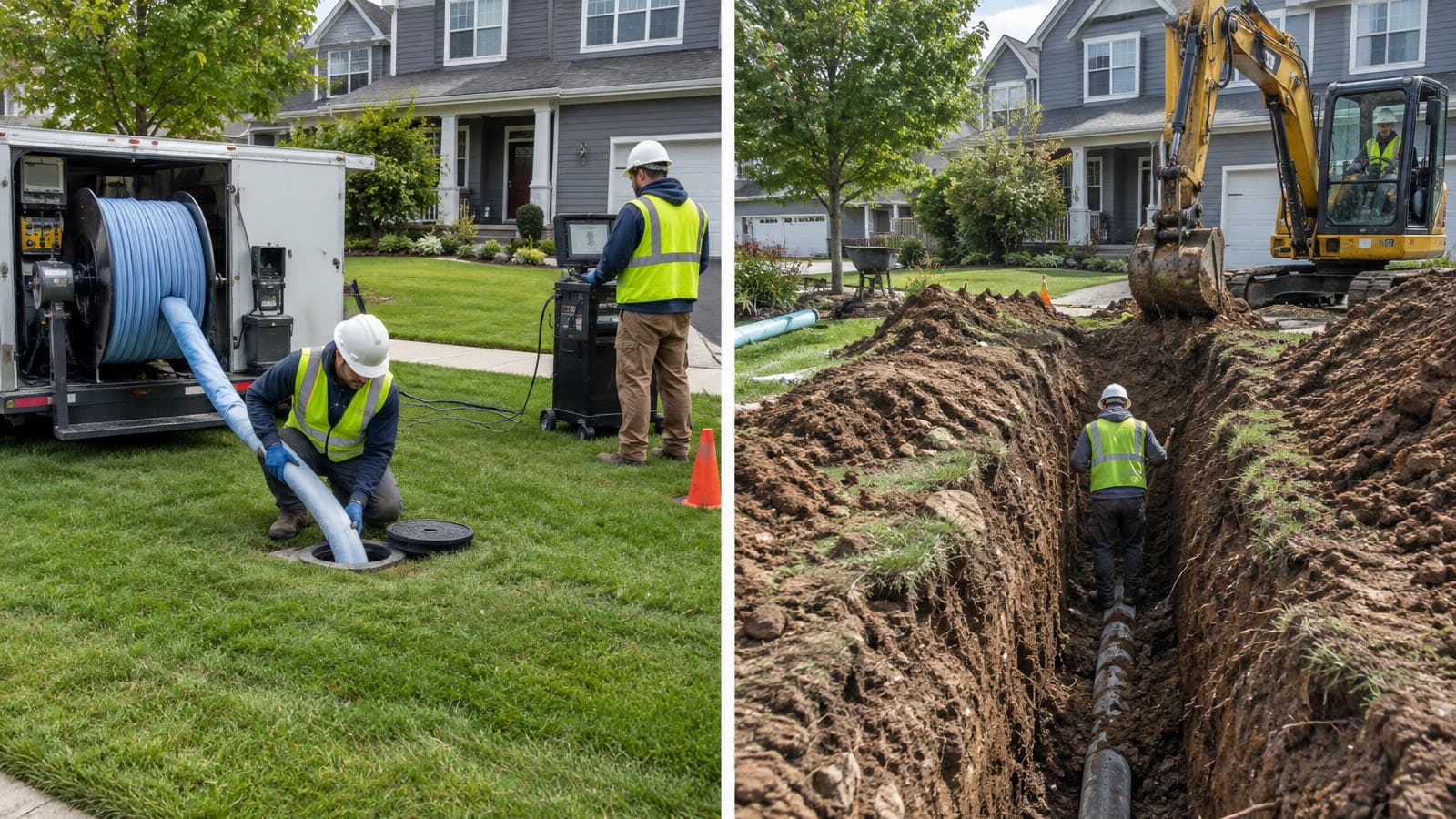
Pipe Relining vs Replacement: Which Solution Is Best?

💰 50-70% Cost Savings
Relining: $80-250/ft • Replacement: $250-500/ft • Same 50-year result
Every property owner with failing sewer or water pipes eventually faces the fundamental decision: repair the existing pipe through trenchless relining, or replace it entirely through traditional excavation? The cost difference proves dramatic—relining typically costs $80-250 per linear foot for materials and installation, while complete replacement runs $250-500+ per foot including excavation, new pipe, backfill, and restoration. This 50-70% cost difference makes relining economically compelling when conditions permit, yet certain situations demand replacement regardless of cost premiums.
Understanding when each approach makes sense requires examining pipe condition, project constraints, and long-term performance expectations. Pipe relining works brilliantly for structurally-adequate pipes with cracks, leaks, or root intrusion—creating new pipes inside old ones without excavation. However, completely collapsed pipes, severe misalignment, or situations requiring diameter increases need replacement through traditional excavation or pipe bursting that destroys old pipes while pulling new ones through.
The decision framework balances multiple factors: initial cost differences, disruption tolerance, property access challenges, timeline urgency, and acceptable diameter reduction. Most residential sewer lateral repairs favor relining's lower costs and minimal disruption. Major property renovations with open excavations already planned might favor replacement's slightly longer lifespan. Collapsed pipes leave no choice—replacement becomes necessary when host pipes cannot support relining installation.
Understanding Both Methods
Pipe relining—also called cured-in-place pipe (CIPP) or trenchless rehabilitation—creates new pipes inside existing damaged pipes without excavation. The most common approach inserts resin-saturated felt liners through existing access points, inflates them against host pipe walls, and cures the resin creating structural pipes bonded to original pipes. The process typically completes in 4-8 hours from setup through final inspection, with pipes returning to full service once curing finishes.
How the New Liner Works:
The new liner becomes the functional pipe—a seamless, corrosion-resistant tube handling all flows and pressures. The old pipe serves as permanent protective casing, shielding the liner from external loads and ground movement. This pipe-within-pipe configuration provides 50-100 year service life matching or exceeding new pipe installations, with manufacturers offering 50-year warranties on properly-installed liners.
Critical Requirements:
The process requires structurally-adequate host pipes maintaining roundness and providing support during installation. Pipes collapsed beyond 30-40% of original diameter cannot accept liner installation. Severely offset joints or completely separated pipe sections prevent liner passage. However, pipes with cracks, root intrusion, corrosion, or moderate structural damage prove ideal relining candidates.
Traditional pipe replacement involves excavating continuous trenches exposing damaged pipes, removing old pipes completely, installing new pipes in trenches, backfilling and compacting soil around new installations, and restoring surfaces to original or improved conditions. The process proves straightforward conceptually but labor-intensive and disruptive practically, requiring heavy equipment, substantial excavation, proper bedding and backfill, and complete surface restoration.
The Complete Solution:
The result delivers genuinely new pipes with 100+ year life expectations—the same infrastructure installed in new construction. No diameter reduction occurs (and upsizing proves possible), connections install easily at any location, and material selection offers complete flexibility. From engineering perspectives, replacement provides the most comprehensive solution—everything above and around pipes gets renewed simultaneously.
The Cost Reality:
However, replacement costs 2-3x more than relining when complete project expenses including excavation, disposal, restoration, and disruption account properly. A 100-foot residential sewer replacement might cost $25,000-50,000+ all-in, while relining the same pipe runs $8,000-15,000. The dramatic cost difference drives relining adoption when pipe conditions permit trenchless approaches.
✅ Relining Advantages
- 50-70% lower cost
- Same-day completion (4-8 hours)
- Zero excavation required
- Minimal property disruption
- Preserves landscaping
- 50-100 year service life
✅ Replacement Advantages
- Genuinely new pipe (100+ years)
- No diameter reduction
- Unlimited connection access
- Handles any damage severity
- Complete material flexibility
- Can upsize pipe diameter
The optimal choice depends on specific conditions—most situations favor relining's advantages, while certain scenarios demand replacement's capabilities regardless of costs.
Cost Comparison
Relining Costs:
Replacement Costs:
Cost Savings Analysis:
This example demonstrates relining's 65% cost savings—$12,500 versus $35,500 for functionally equivalent 50-year pipe rehabilitation. The savings prove even more dramatic when properties have extensive landscaping, mature trees, paved driveways, or other features requiring expensive restoration after excavation.
Beyond Direct Construction Expenses:
Replacement creates hidden costs often exceeding budgets:
- Landscape destruction: Mature trees, shrubs, gardens, and lawns requiring years to reestablish—aesthetic and property value impact persists long after construction completes
- Hardscape replacement: Driveway or patio removal and replacement adds $5,000-15,000+ depending on materials and size
- Tree damage: Root zone disturbance can kill valuable mature trees worth thousands in property value
- Disruption costs: Weeks of construction—equipment noise, contractor access, property unusability—impose lifestyle costs difficult to quantify but very real
- Business downtime: Commercial properties lose revenue during extended construction periods
Real Example: A mature oak tree (30+ years old) provides $8,000-15,000 in property value. Driveway replacement runs $10,000-20,000. Landscape restoration costs $5,000-15,000. These "hidden" costs can double the replacement bill from $35,000 to $70,000+.

When Relining Is Best
Structural Requirements:
Pipe relining proves optimal when host pipes retain adequate structural integrity—generally 50%+ of original strength. Video inspection reveals whether pipes maintain sufficient roundness for liner installation and adequate joint alignment allowing liner passage. The 3-6% diameter reduction from liner thickness proves acceptable for most residential and commercial applications—a 6-inch sewer becomes 5.5-5.75 inches post-relining, maintaining more than adequate flow capacity for typical use.
Situations Strongly Favoring Relining:
✅ Property Conditions:
- Limited access situations (beneath buildings)
- Mature landscaping preservation priority
- Paved driveways over pipe routes
- Urban locations with access constraints
- Properties with valuable mature trees
✅ Project Constraints:
- Cost-sensitive budgets (50-70% savings)
- Time-critical repairs (same-day service)
- Minimal disruption requirements
- Occupied homes/businesses
- Regulatory excavation restrictions
Damage Types Relining Handles Well:
- Cracks from ground settlement or traffic loads: Seal completely with relining
- Joint failures: Infiltration/exfiltration closes permanently
- Root intrusion: After thorough cleaning, presents no obstacle
- Corrosion/deterioration: Cast iron, clay, or concrete receives new corrosion-resistant liners
- Moderate structural damage: Maintaining 50%+ integrity supports liner installation
Targeted Spot Repair Option:
For isolated damage in otherwise sound pipes, targeted spot repair may provide more economical solutions than full-length relining. This approach rehabilitates only damaged sections while leaving undamaged pipe segments untouched.
Conditions Unsuitable for Relining:
- Complete pipe collapse preventing liner passage
- Severely offset joints (>30-40% of diameter)
- Pipes deteriorated beyond structural adequacy
- Catastrophic structural failure (0-40% integrity remaining)
These conditions require replacement approaches—either traditional excavation or pipe bursting.
When Replacement Is Necessary
Absolute Requirements for Replacement:
- Complete pipe collapse: Prevents liner passage—no choice but replacement
- Severe misalignment/offset: Exceeds liner flexibility, requires realignment
- Inadequate diameter: Current or projected flows necessitate upsizing
- Extreme root damage: Destroys pipes beyond structural adequacy
- Multiple connection points: Requiring easy access (commercial/industrial)
Replacement Methods Available:
Traditional excavation: Complete trench, remove old pipe, install new—maximum disruption but complete access
Pipe bursting: Break old pipes while pulling new ones through—combines replacement benefits with reduced excavation compared to traditional methods. Learn more about pipe bursting as a replacement alternative.
When Replacement Makes Strategic Sense:
- New construction projects: Trenching already planned for other utilities—might as well replace pipes while excavation equipment operates on-site
- Open trench situations: Eliminate relining's primary advantage—minimal disruption matters less when trenches exist regardless
- Major property renovations: Extensive landscaping replacement planned anyway removes cost barriers to replacement
- Sewer line relocations: Additions, pools, or improvements require new installations rather than rehabilitating pipes in wrong locations
- Diameter upsizing required: Growing water demands or increased flow capacity needs pipe size increases impossible with relining
Long-Term Value Considerations:
Replacement delivers genuinely new pipes with 100+ year life expectations—the maximum possible longevity. Relining provides 50-100 year extended life depending on original pipe condition and liner specification—excellent longevity falling slightly short of new pipe theoretical maximum. However, both approaches offer multi-generational performance far exceeding immediate needs. The choice depends on current conditions and constraints rather than marginal longevity differences.

Decision Framework
| Decision Factor | Favors Relining When... | Favors Replacement When... |
|---|---|---|
| 1. Host Pipe Condition | Structural integrity 50%+ maintained, roundness adequate | Complete collapse, severe misalignment, <50% integrity |
| 2. Budget Constraints | Limited budgets favor 50-70% cost savings | Unlimited budgets might choose marginal longevity gains |
| 3. Disruption Tolerance | Occupied properties, operational businesses, minimal impact priority | Vacant properties, major renovations tolerate disruption |
| 4. Property Access | Pipes under structures, mature landscaping, difficult access | Open access areas permit replacement consideration |
| 5. Timeline Urgency | Emergency repairs, rapid restoration required (1 day) | Planned maintenance, flexible schedules tolerate 3-4 weeks |
| 6. Diameter Requirements | Current diameter adequate, 3-6% reduction acceptable | Upsizing needed, diameter increase required for capacity |
Decision Rule of Thumb:
If 4+ factors favor relining and pipe condition permits (50%+ structural adequacy), relining represents the optimal choice delivering equivalent performance at 50-70% cost savings with minimal disruption. If pipe collapse or diameter increase requirements exist, replacement becomes necessary regardless of other preferences.
Total Cost of Ownership Analysis:
A well-installed CIPP liner lasting 75 years provides identical practical value to new pipe lasting 100 years when property ownership horizons span decades not centuries. Both approaches far exceed typical homeownership periods (7-15 years national average), making longevity differences academically interesting but practically irrelevant.
50-Year Cost Comparison (100-foot sewer):
Relining Lifecycle Costs:
Replacement Lifecycle Costs:
Lifecycle Value Advantage:
Relining provides $60,000 advantage over replacement when accounting for initial costs, ongoing maintenance, property value preservation, and avoided disruption. The "cheaper" method (relining) delivers superior total value across realistic ownership horizons.
Frequently Asked Questions
Properly-installed CIPP pipe liners provide 50-100 year service life with manufacturers offering 50-year warranties. Traditional replacement delivers 100+ year expectations for new pipes. Both approaches offer multi-generational performance far exceeding typical property ownership periods. The practical difference proves minimal—both outlast most homeowners' ownership horizons by decades.
Relining reduces internal diameter by 3-6% depending on liner thickness and pipe size. A 6-inch sewer becomes 5.5-5.75 inches post-relining, a 4-inch becomes 3.75-3.85 inches. This reduction proves insignificant for residential and most commercial applications—flow capacity remains more than adequate for typical use. The smooth, seamless liner interior actually improves flow efficiency compared to corroded or root-infiltrated original pipes despite the modest diameter reduction.
Relining requires host pipes maintaining 50%+ structural integrity. Completely collapsed pipes (crushed flat or separated), severely offset joints preventing liner passage, or pipes deteriorated beyond structural adequacy cannot be relined. Video inspection determines suitability—if camera equipment can traverse the pipe and structural roundness remains adequate, relining typically proves feasible. When relining isn't possible, pipe bursting or traditional replacement become necessary alternatives.
No—relining creates permanent, structural rehabilitation equivalent to new pipe installation. The cured liner forms a standalone pipe capable of handling all design loads and pressures. With 50-100 year life expectations and 50-year manufacturer warranties, relining delivers permanent solutions, not temporary patches. The liner becomes the functional pipe while the host pipe serves as permanent protective casing—a engineered system providing multi-generational service life.
Existing lateral connections reinstate through robotic cutting after liner installation—standard procedure included in complete relining projects. New lateral connections require cutting through both liner and host pipe, then sealing with specialized boots or collars—technically feasible but more complex than replacement's open-trench access. Properties requiring multiple new connections might favor replacement for easier access, while properties with existing connections only find relining entirely suitable.
Video camera inspection provides definitive assessment—specialized contractors insert cameras through cleanouts to evaluate pipe condition, structural integrity, joint alignment, and damage severity. Inspection costs $200-500 typically and delivers footage showing exactly what exists underground. Based on inspection results, contractors recommend relining (if 50%+ structural adequacy exists) or replacement (if collapse or severe damage present). This diagnostic step proves essential before committing to either approach.
Conclusion: Making the Right Choice
The pipe relining versus replacement decision hinges primarily on pipe condition and project constraints. When host pipes retain 50%+ structural integrity, relining delivers equivalent 50-year rehabilitation at 50-70% cost savings ($80-250/ft vs $250-500/ft) with same-day completion and zero property disruption. These dramatic advantages make relining the default choice when conditions permit.
However, completely collapsed pipes, severe misalignment, or diameter increase requirements necessitate replacement regardless of cost premiums—relining simply cannot address these conditions. Similarly, properties undergoing major renovations with excavation already planned might rationally choose replacement for marginal longevity gains when disruption costs disappear.
For most residential and commercial pipe rehabilitation projects, relining provides superior value—lower costs, faster completion, minimal disruption, and functionally-equivalent performance across realistic ownership horizons. Understanding your specific pipe condition through professional video inspection informs the optimal choice protecting both property values and budgets. For comprehensive guidance on trenchless rehabilitation methods, explore our complete technology comparisons.
Ready to Assess Your Pipes?
Connect with experienced contractors for video inspection and rehabilitation recommendations.
Find Local Contractors