

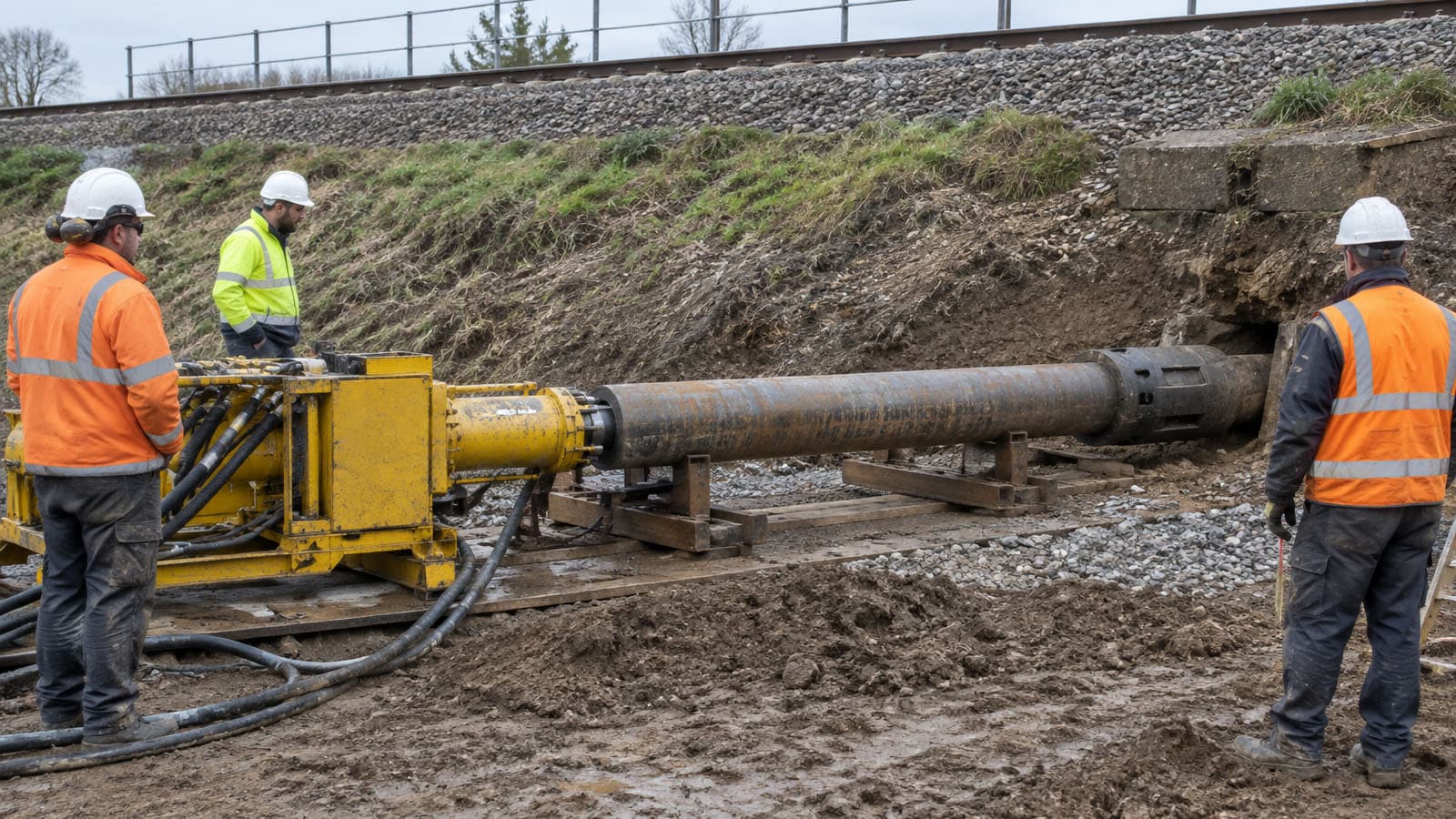
Pipe Ramming Technique: Impact-Driven Casing Installation

🔨 Brute Force Installation
Percussion-driven • Works in ANY soil • Straight-line power
Pipe ramming represents the "brute force" approach to trenchless installation, using massive pneumatic hammers to percussion-drive steel casing through ground via repeated high-energy impacts. Where methods like directional drilling emphasize precision steering and micro-tunneling delivers laser-guided accuracy, pipe ramming abandons steering entirely in favor of maximum penetration force—driving straight-line casings through rock, cobbles, clay, sand, or any soil condition via sheer impact power.
The fundamental mechanism distinguishes ramming from drilling or boring methods: rather than cutting or excavating material, the pneumatic hammer delivers 80-180 percussion blows per minute directly to the pipe end, with each impact transferring 200-400 tons of force driving the pipe forward while displacing soil sideways. This soil displacement approach—pushing material aside rather than removing it—proves remarkably effective in difficult ground conditions where drilling methods struggle, since obstacles like boulders or rock layers simply displace rather than halting progress.
When percussion power beats precision steering becomes clear through application analysis and ground condition assessment. Short straight-line crossings beneath roads or railroads, projects requiring robust steel casing protection, installations through rock or cobbled soil that challenges drilling equipment, or cost-sensitive casing installations where ±2-3 inch accuracy suffices all favor pipe ramming's straightforward impact-driven approach. The technology costs $100-250 per foot—positioned between basic HDD and sophisticated micro-tunneling—offering mid-range pricing for applications prioritizing steel casing strength and universal soil capability over steering flexibility or extreme precision.
Understanding Pipe Ramming Technology
Pipe ramming creates underground pathways through percussion force rather than cutting or drilling. A massive pneumatic hammer—weighing 3,000 to 8,000 pounds—mounts directly on the rear end of steel casing pipe, delivering repeated high-energy impacts that drive the pipe forward through ground via soil displacement rather than excavation.
Pneumatic Hammer Operation:
The pneumatic hammer operates via compressed air (typically 350-750 CFM at 90-125 PSI) driving an internal piston that delivers 80-180 percussion blows per minute. Each impact transfers 200-400 tons of instantaneous force through the pipe structure, with the cumulative effect advancing the casing forward while soil displaces around and ahead of the leading edge. This percussion mechanism proves remarkably simple compared to the complex guidance systems of HDD or laser tracking of micro-tunneling—the hammer simply pounds forward with maximum force.
Soil Displacement vs Excavation:
The fundamental distinction between ramming and drilling methods lies in material handling. Pipe ramming displaces soil sideways and forward through compaction and lateral movement—no material leaves the work zone except through the pipe interior in open-end configurations. This soil displacement mechanism provides exceptional capability in difficult ground conditions, since boulders, rock layers, or cobbles simply push aside rather than requiring cutting or breaking.
Open-End vs Closed-End Configurations:
Open-end ramming removes displaced soil from pipe interior via auger or compressed air, allowing distances of 100-300+ feet. Closed-end ramming drives solid capped pipe through ground with pure displacement, limiting distances to 30-100 feet but simplifying operations by eliminating spoil handling requirements.
| Feature | Pipe Ramming | HDD | Micro-Tunneling |
|---|---|---|---|
| Installation Method | Percussion impact | Rotary drilling | Boring + jacking |
| Steering Capability | None (straight-line only) | Yes (steerable) | Yes (laser-guided) |
| Accuracy | ±2-3% of length | ±12 inches | ±0.5-1 inch |
| Soil Capability | ANY (rock to sand) | Stable soils best | Good all conditions |
| Cost Per Foot | $100-250/ft | $50-150/ft | $200-600/ft |
| Pipe Type | Steel casing only | HDPE typical | Concrete common |
| Best Application | Short straight casings | Long flexible runs | Precision sewers |
| Distance Range | 50-300 feet typical | 500-3,000+ feet | 300-1,500 feet |
Method Selection Principle:
Ramming excels for straight-line steel casing installations through difficult soil where steering unnecessary and robust protection required. HDD handles flexible alignment requirements over longer distances. Micro-tunneling delivers precision for gravity sewers. Each technology serves distinct applications—appropriate selection depends on project-specific requirements balancing trajectory, accuracy, soil conditions, and casing type.

The Pipe Ramming Process
Entry Pit Excavation:
The working shaft provides space for ramming frame installation, pipe staging, hammer mounting, and operation. Entry pits typically measure 12x25 feet for medium installations, with depth providing adequate clearance for equipment setup. Proper shoring maintains pit stability, while leveled base surfaces ensure accurate pipe alignment.
Ramming Frame Installation:
The ramming frame—structural steel guide rails—mounts in the entry pit to maintain pipe alignment throughout installation. Frame levelness and alignment prove critical since the pneumatic hammer provides no steering correction—initial trajectory determines final pipe location. Laser alignment systems verify setup accuracy before ramming begins.
Exit Pit or Reception Area:
Exit pits provide space for pipe emergence and hammer recovery. For shorter installations, small reception pits suffice. Longer runs may require intermediate recovery shafts if distance exceeds single-push capability.
Steel Casing Selection:
Steel casing pipe must withstand both ramming forces and service loads. Wall thickness selection balances structural capacity against project economics, typically ranging from 0.375 to 1.0 inches depending on diameter and installation length. For open-end ramming, cutting shoes (hardened steel conical leading edges) attach to pipe ends, penetrating soil while guiding material into pipe interior for removal.
Pneumatic Hammer Activation:
Once pipe positioning and frame alignment verification complete, compressed air activates the pneumatic hammer. The operator monitors impact frequency (typically 80-180 blows per minute), advance rate (10-50 feet per day depending on soil), and alignment throughout installation. As pipe sections advance, crews weld additional 20-40 foot sections to extend the casing, with ramming pausing during welding operations.
Progress Monitoring:
Continuous monitoring ensures installation stays within acceptable parameters. Advance rate indicates soil resistance—slower progress may signal obstacles or alignment issues. Periodic surveying confirms pipe remains within tolerance specifications.
Open-End Spoil Removal:
For open-end installations, auger systems or compressed air convey displaced soil from pipe interior back to entry pit. Intermittent removal pauses ramming periodically for spoil extraction, while continuous systems operate simultaneously with hammer percussion. Closed-end installations eliminate spoil removal entirely, driving solid capped pipe through ground.
Hammer Removal & Carrier Pipe:
Upon reaching target distance, crews disconnect the pneumatic hammer for extraction. For casing installations, carrier pipes (the actual utility pipe) insert through the steel casing after ramming completes, with the casing providing permanent protection. End connections integrate new casing with existing infrastructure, and entry/exit pit restoration completes the project.

Types of Pipe Ramming
Open-End Ramming (Most Common):
Open-end ramming removes spoil from pipe interior as installation proceeds, allowing distances of 100-300+ feet. The cutting shoe at pipe leading edge penetrates soil while guiding displaced material into pipe interior, where auger or compressed air systems transport it back to entry pit. This configuration handles the majority of ramming applications, providing practical range for road and railroad crossings while managing soil displacement through controlled removal.
Closed-End Ramming (Shorter Distances):
Closed-end ramming drives solid capped pipe through ground with 100% soil displacement—no material enters or exits the pipe interior. This simpler approach eliminates spoil handling equipment and operations, reducing mobilization costs and setup complexity. However, cumulative soil resistance limits distances to 30-100 feet typically, since friction increases with length as displaced soil compacts around pipe exterior. Applications include short utility crossings or temporary casing installations where distance constraints prove acceptable.
Micro-Ramming (Small Diameters):
Micro-ramming addresses smaller diameter applications (4-16 inches typical) using specialized compact equipment. These installations suit residential utility connections, telecommunications conduit, or short crossings where larger ramming systems prove impractical. Equipment scaling reduces costs while maintaining percussion installation advantages for difficult soil conditions.
Advantages and Limitations
Major Advantages:
- Universal soil capability: Works in ANY soil type—rock, cobbles, clay, sand, mixed conditions
- Simple operation: No steering complexity means straightforward installation
- Boulder displacement: Obstacles pushed aside rather than requiring excavation
- Steel casing strength: Maximum protection for carrier pipes
- Cost-effective for application: $100-250/ft mid-range pricing
- Proven technology: 50+ years of successful installations
- Fast for short runs: Efficient completion on suitable projects
- Minimal equipment: Hammer, frame, compressor—straightforward setup
Important Limitations:
- No steering capability: Straight-line only—cannot correct trajectory
- Limited accuracy: ±2-3% of length (vs ±12 inches HDD, ±0.5-1 inch MT)
- Noise and vibration: Percussion impacts create disturbance concerns
- Steel casing only: Cannot install plastic or flexible pipes
- Entry/exit pits required: Still need excavation at both ends
- Distance limits: Shorter maximum than HDD (300 feet vs 3,000+ feet typical)
- Alignment critical: Initial setup determines final position—no corrections
Ideal Applications
Perfect Pipe Ramming Applications:
- Road crossings: Short straight installations under highways (50-250 feet typical)
- Railroad crossings: Steel casing protection for utility lines
- Rocky soil conditions: Where HDD drilling struggles with hard formations
- Mixed soil: Cobbles, boulders, variable conditions that challenge boring
- Utility protection casings: Steel strength for carrier pipe safeguarding
- Cost-sensitive projects: Mid-range pricing when precision unnecessary
- Short straight runs: Where steering flexibility not required
Pipe Types and Sizes:
Steel casing dominates pipe ramming applications, available in 4-72 inch diameters with wall thickness ranging 0.375-1.0 inches depending on project requirements. Welded or seamless steel pipe options provide flexibility for various applications. After ramming completes, carrier pipes (the actual utility lines) insert through steel casing for permanent installation, with the casing providing protection against external loads, future excavation damage, and soil movement.
Costs & Pricing
Pipe ramming typically costs $100-250 per linear foot for installation—positioned between basic HDD and sophisticated micro-tunneling. This mid-range pricing reflects straightforward equipment and operations balanced against steel casing material costs and shorter practical distances distributing mobilization expenses.
Cost Components:
- Entry pit excavation: $10,000-30,000 depending on depth and conditions
- Exit pit: $5,000-15,000 (smaller than entry typically)
- Steel casing material: $50-100/ft depending on diameter and wall thickness
- Ramming installation: $50-150/ft for equipment and labor
- Mobilization/demobilization: $8,000-20,000 typical
Competitive Positioning:
At $100-250/ft, pipe ramming costs less than micro-tunneling ($200-600/ft) but more than basic HDD ($50-150/ft). The premium over HDD reflects steel casing material costs and universal soil capability. The savings versus micro-tunneling come from simpler equipment and operations. For applications requiring steel casing through difficult ground over straight-line paths, ramming delivers optimal economics. For additional cost comparisons, review our complete cost breakdown.
Frequently Asked Questions
Pipe ramming achieves ±2-3% of installation length accuracy—significantly less precise than HDD (±12 inches) or micro-tunneling (±0.5-1 inch). For a 100-foot installation, expect ±2-3 feet positioning uncertainty. This limited accuracy reflects the straight-line percussion approach without steering correction. Applications must tolerate this positioning variance, making ramming unsuitable for precision-critical installations but acceptable for utility protection casings where exact location proves less critical.
Yes, pipe ramming excels in rock and difficult soil conditions that challenge drilling methods. The percussion impact force (200-400 tons per blow) displaces rock rather than cutting it, with boulders and rock layers simply pushed aside or fractured by repeated impacts. This capability makes ramming particularly valuable for installations through cobbled fills, rocky formations, or mixed soil conditions where HDD struggles. However, solid bedrock may slow advance rates significantly.
Open-end ramming removes displaced soil from pipe interior via auger or compressed air, allowing distances of 100-300+ feet. Closed-end ramming drives solid capped pipe with 100% soil displacement and no spoil removal, limiting distances to 30-100 feet but simplifying operations. Choose open-end for longer crossings requiring spoil management, closed-end for shorter installations prioritizing operational simplicity.
Pipe ramming beats HDD when: (1) straight-line trajectory acceptable—no steering needed, (2) rocky or difficult soil challenges drilling equipment, (3) steel casing strength required rather than HDPE flexibility, (4) boulders or obstacles need displacement rather than cutting, or (5) shorter distances favor ramming's simple setup. HDD wins for longer runs, flexible alignment requirements, or stable soil conditions where steering advantages justify approach differences.
Pipe ramming advances 10-50 feet per day typically, with actual rates depending on soil conditions, pipe diameter, and installation length. A 150-foot road crossing might complete in 5-8 days including setup and demobilization. This proves faster than micro-tunneling (which might require 12-15 days for similar distance) but slower than HDD (2-3 days typical). The trade-off balances speed against other project requirements like soil capability and casing type.
Conclusion: Pipe Ramming as Percussion Solution
Pipe ramming occupies the "brute force" niche within trenchless installation technology, delivering straight-line steel casing installation through any soil condition via percussion impact rather than precision guidance. This approach—abandoning steering for maximum penetration power—proves optimal when trajectory flexibility matters less than universal soil capability, steel casing strength, and straightforward operations.
Understanding when percussion power justifies accuracy limitations requires honest assessment of project requirements versus method capabilities. Short straight crossings through difficult ground, utility protection casings prioritizing steel strength, installations through rock or cobbles that challenge drilling equipment, or cost-sensitive projects where ±2-3% positioning accuracy suffices all favor pipe ramming's impact-driven simplicity. However, applications requiring steering flexibility, extreme precision, or longer distances benefit from HDD's steerable drilling or micro-tunneling's laser guidance. For additional guidance on trenchless methods, explore our comprehensive technology comparisons.
Ready to Find Pipe Ramming Contractors?
Connect with experienced pipe ramming specialists for steel casing installations through any soil condition.
Find Pipe Ramming Specialists