

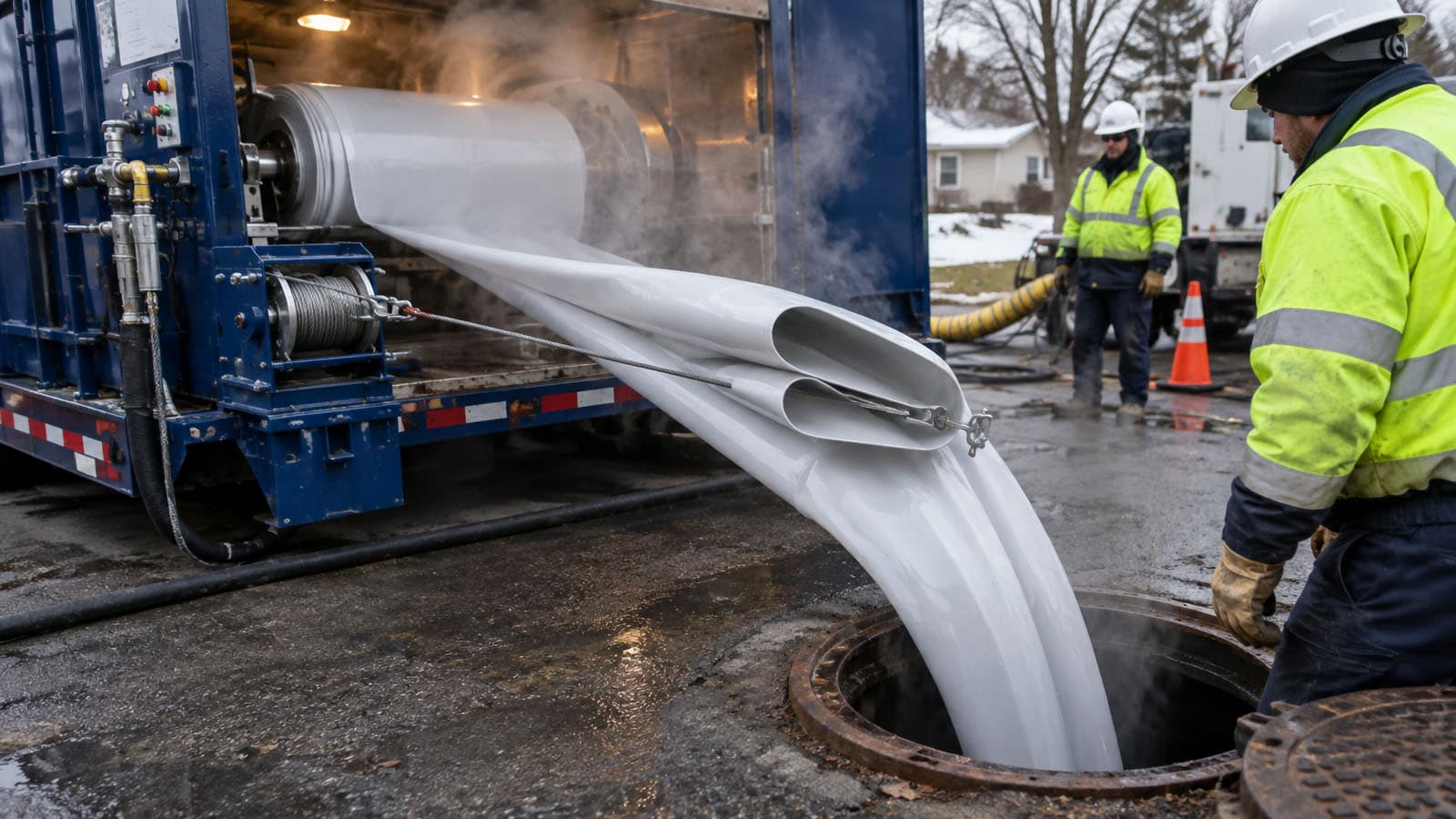
Folded & Formed Lining: Minimal Diameter Loss Method
.png)
📏 1-3% Diameter Loss
Preserves 97-99% capacity • Half the loss of CIPP • Specialized thermoplastic technology
Folded and formed lining—also called fold-and-form or deformed pipe lining—represents a specialized trenchless rehabilitation method minimizing diameter reduction through innovative thermoplastic pipe technology. Unlike traditional CIPP lining that reduces interior diameter 3-6% or slip lining sacrificing 10-20%, fold-and-form technology loses only 1-3% of original diameter through temporary pipe deformation enabling insertion followed by shape restoration to nearly full round configuration.
The diameter advantage versus traditional methods defines fold-and-form's specialized niche. In capacity-constrained systems where every inch of diameter affects hydraulic performance, the difference between 3% CIPP reduction and 1% fold-and-form loss proves significant—a 12-inch pipe reduced to 11.6 inches (CIPP) versus 11.9 inches (fold-and-form) maintains 5% greater flow area. This seemingly modest advantage justifies fold-and-form's 15-40% cost premium ($120-300 vs $80-250/ft) when capacity limitations create operational or regulatory concerns.
When minimal diameter reduction matters becomes clear through hydraulic analysis and system capacity evaluation. Water distribution systems operating near capacity cannot tolerate significant flow restriction. Gravity sewers with marginal grades where reduced diameter creates settling problems favor minimal reduction. Industrial process pipes with precise flow requirements demand maximum preserved capacity. Regulatory requirements specifying minimum diameters after rehabilitation create compliance needs favoring fold-and-form approaches.
Understanding Fold-and-Form Technology
Fold-and-form technology exploits thermoplastic materials' ability to deform temporarily under controlled conditions then recover original shapes when heated. The process begins with manufactured thermoplastic pipes—typically HDPE or modified PE formulations—temporarily deformed through folding, rolling, or compression reducing cross-sectional dimensions by 40-50%. This reduced profile allows insertion through host pipes similar to conventional liner installation but with less friction and easier navigation due to smaller insertion diameter.
Shape Restoration Process:
Once positioned within host pipes, shape restoration occurs through controlled heating—steam, hot water, or hot air applied to deformed liners triggers thermoplastic "shape memory" causing pipes to expand back toward original round configurations. The expansion generates pressure against host pipe interiors, creating tight fits without requiring external inflation like CIPP methods. Cooling stabilizes restored shapes, with final dimensions typically 97-99% of original liner diameters—the 1-3% reduction represents unavoidable wall thickness occupation plus minor recovery limitations.
Mechanical Principles:
The mechanical principles differ fundamentally from CIPP's resin curing or slip lining's physical pipe insertion. No chemical reactions occur—purely physical deformation and thermal recovery drive the process. No thick resin-saturated felt occupies diameter—thin-wall thermoplastic provides structural capacity. The result delivers minimal diameter loss impossible through conventional approaches, though at cost premiums reflecting specialized materials, proprietary processes, and limited contractor availability.
CIPP Lining
3-6% Loss
12" → 11.3-11.6"
91-97% Flow Capacity
$80-250/ft
Slip Lining
10-20% Loss
12" → 9.6-10.8"
64-81% Flow Capacity
$50-150/ft
Fold-and-Form
1-3% Loss
12" → 11.6-11.9"
97-99% Flow Capacity
$120-300/ft
Understanding the Differences:
CIPP lining: 3-6% diameter reduction from liner wall thickness—a 12-inch pipe becomes 11.3-11.6 inches post-lining. The felt tube plus cured resin thickness occupies significant space, with thicker liners required for structural applications creating greater reduction. Most applications tolerate this loss easily, but capacity-constrained systems face flow restriction concerns.
Slip lining: 10-20% diameter reduction from inserting smaller manufactured pipes—a 12-inch host receives 10-10.8 inch liners depending on clearance requirements and liner wall thickness. The dramatic reduction suits applications accepting substantial capacity loss but proves unacceptable for hydraulically-critical systems.
Fold-and-form lining: 1-3% diameter reduction from minimal wall thickness plus recovery limitations—a 12-inch pipe maintains 11.6-11.9 inches post-restoration. This minimal loss preserves maximum flow capacity, maintaining 97-99% of original hydraulic performance versus 91-97% for CIPP.
When Every Inch Matters:
The difference between 11.6-inch (CIPP) and 11.9-inch (fold-and-form) final diameters provides 5% greater flow area—potentially significant for capacity-limited systems where regulatory requirements, operational demands, or hydraulic constraints create diameter preservation priorities. Alternative UV-cured lining methods offer similar 3-6% reduction with faster installation but not fold-and-form's minimal diameter loss.
Fold-and-form technology exists through various proprietary systems developed by different manufacturers—each employing distinct deformation methods, thermoplastic formulations, and restoration processes protected by patents. This proprietary nature creates both technology advancement through competitive innovation and market challenges through limited contractor availability and potential cost impacts from restricted competition.
Important Considerations:
Property owners evaluating fold-and-form options should understand available systems differ in capabilities, costs, and contractor accessibility, requiring careful investigation matching specific project needs with available technologies. Limited contractor availability varies dramatically by region—some areas have multiple fold-and-form specialists while others lack any local providers.

The Fold-and-Form Process
Comprehensive Preparation:
The process begins with comprehensive video inspection documenting host pipe conditions, verifying dimensions, identifying obstructions, and confirming adequate structural integrity supporting fold-and-form installation. Cleaning requirements match or exceed CIPP standards—the restored liner must seat properly against host pipe interiors, demanding thorough debris removal.
Controlled Deformation:
Liner deformation occurs in controlled manufacturing environments where thermoplastic pipes undergo folding, rolling, or compression reducing cross-sections to 50-60% of original diameters. The specific deformation method varies by proprietary system—some fold pipes flat creating C-shapes, others roll pipes into spiral configurations, while additional approaches use different compression techniques. All methods share the objective of creating reduced profiles enabling insertion through host pipes while maintaining thermoplastic integrity for subsequent shape recovery.
Pull-In-Place Installation:
Installation proceeds through pull-in-place methods similar to CIPP—the deformed liner draws through host pipes from entry to exit points. Reduced friction from smaller insertion profiles often allows longer continuous pulls compared to CIPP, with positioning verified before restoration begins.
Thermal Shape Restoration:
Shape restoration applies controlled heat through steam injection, hot water circulation, or hot air delivery depending on system specifications and site conditions. The heating triggers thermoplastic recovery—deformed cross-sections expand toward original round configurations as material "remembers" manufactured shapes. The expansion generates 5-15 PSI pressure against host pipe interiors, creating intimate contact without requiring external inflation equipment. Restoration typically completes within 2-4 hours, with cooling periods stabilizing final dimensions before service restoration.
Final Operations:
Final operations include lateral reinstatement through robotic cutting or manual access, end connection preparation and sealing, comprehensive inspection verifying shape recovery and installation quality, and service restoration once all completion criteria satisfy. The entire process from setup through service restoration typically spans 6-12 hours depending on project length and complexity—longer than CIPP but providing minimal diameter loss justifying extended timelines for capacity-critical applications.
Advantages & Limitations
Diameter Preservation Benefits:
- Preserves 97-99% of original diameter
- 5% greater flow area vs CIPP
- Critical for capacity-constrained systems
- Water distribution networks benefit
- Gravity sewers maintain velocity
- Industrial precise flow requirements
Additional Benefits:
- No curing time (2-4 hours restoration)
- No resin odors/VOC emissions
- Clean thermoplastic process
- Potable water suitable
- Immediate service after cooling
- 50-100 year service life
Minimal Diameter Loss Impact:
The defining advantage involves preserving 97-99% of original pipe diameter versus 94-97% for CIPP or 80-90% for slip lining. This 2-6% incremental preservation translates to 4-12% greater flow area retention compared to CIPP—potentially significant differences for capacity-constrained systems.
Cost Considerations:
- 15-40% premium over CIPP ($120-300 vs $80-250/ft)
- Specialized materials more expensive
- Proprietary licensing fees
- Limited contractor competition
- Extended installation procedures
Availability Constraints:
- Limited contractor availability
- Many regions lack local providers
- Proprietary system dependencies
- Vendor lock-in concerns
- Less field performance data vs CIPP
Technical Constraints:
- Host pipe integrity required: Adequate structural capacity supporting liner installation
- Temperature-sensitive procedures: Careful thermal management throughout restoration
- Shape recovery challenges: Severely deformed hosts may prevent 99% restoration
- Limited size range: Most systems focus on 4-24 inch diameter range
Cost justification critical: The fold-and-form cost disadvantage proves acceptable only when diameter preservation justifies incremental expense—capacity-critical applications absorb premiums while routine rehabilitation favors CIPP's lower costs.

Ideal Applications
Applications Where Minimal Diameter Loss Justifies Premium:
- Capacity-constrained water distribution: Peak demand approaches pipe capacity, 2-3% difference prevents system upgrades
- Hydraulically-critical pipes: Flow restriction creates cascading system problems
- Water mains: Minimal diameter loss plus clean installation without resin curing concerns
- Regulatory compliance: Minimum diameter requirements after rehabilitation
- Environmental sensitivity: Clean thermoplastic process preferred over resin systems
- Pressure sewer force mains: Capacity matters but gravity grades irrelevant
- Industrial process pipes: Precise flow requirements benefit from maximum preserved capacity
Typical Size Range:
The typical 4-24 inch diameter range covers most municipal and commercial applications, though availability outside this range proves limited. Water distribution mains represent primary fold-and-form markets—the potable water application benefits from both minimal reduction and clean installation process.
Costs & Availability
Cost Structure:
Fold-and-form installation typically costs $120-300 per linear foot—15-40% premiums over CIPP's $80-250 range. The higher costs reflect specialized thermoplastic materials, proprietary technology licensing, limited contractor competition, and extended installation procedures.
Break-Even Analysis:
Break-even analysis considers capacity value—if 2-3% additional preserved diameter enables avoiding parallel pipe installation, system capacity upgrades, or operational restrictions, fold-and-form premiums prove economically justified. For comprehensive cost comparisons across all trenchless methods, review our complete cost breakdown.
| Factor | CIPP (Standard) | Fold-and-Form (Premium) |
|---|---|---|
| Cost Per Foot | $80-250 | $120-300 (15-40% premium) |
| Diameter Loss | 3-6% | 1-3% |
| Flow Capacity Retained | 91-97% | 97-99% |
| Installation Time | 4-8 hours | 6-12 hours |
| Contractor Availability | Widespread nationwide | Limited regional coverage |
| Best Applications | Routine rehabilitation | Capacity-critical systems |
Availability Varies by Region:
Contractor availability varies dramatically by region—some areas have multiple fold-and-form specialists while others lack any local providers. Longer mobilization distances for distant contractors add costs and scheduling complexity. The limited market maturity versus CIPP's widespread availability affects both pricing and contractor selection options.
Frequently Asked Questions
Fold-and-form lining reduces interior diameter by only 1-3%—substantially less than CIPP's 3-6% or slip lining's 10-20%. A 12-inch pipe maintains 11.6-11.9 inches after fold-and-form installation versus 11.3-11.6 inches with CIPP. This minimal loss preserves 97-99% of original flow capacity compared to 91-97% for CIPP—a meaningful difference for capacity-constrained systems.
Fold-and-form proves better for capacity-critical applications where minimal diameter loss justifies 15-40% cost premiums. CIPP remains superior for routine rehabilitation where 3-6% reduction proves acceptable and lower costs matter more than incremental capacity preservation. Neither technology is universally better—appropriate selection depends on whether capacity constraints justify fold-and-form premiums or standard CIPP suffices.
Higher costs reflect specialized thermoplastic materials versus commodity resin systems, proprietary technology licensing fees, limited contractor competition in nascent markets, extended installation procedures requiring 6-12 hours versus 4-8 for CIPP, and specialized equipment investments. The 15-40% premium proves justified only when diameter preservation creates sufficient value through avoided capacity upgrades or operational improvements.
No, fold-and-form requires structurally-adequate host pipes similar to CIPP—the host must maintain roundness, provide support during installation, and offer reaction surfaces for expansion pressure during shape restoration. Completely collapsed pipes, severely offset joints, or structurally-deficient sections prevent successful fold-and-form installation just as they preclude CIPP. Video inspection determines whether host pipe conditions suit fold-and-form rehabilitation or require alternative approaches.
Fold-and-form technology demonstrates technical viability through thousands of successful installations over 20+ years. However, the limited installation base versus CIPP's millions of feet and decades of field performance creates understandable conservatism. The technology proves reliable for appropriate applications but lacks CIPP's extensive long-term performance data. Most engineers and utilities accept fold-and-form for capacity-critical applications while defaulting to proven CIPP for routine work.
Conclusion: Niche Solution for Diameter-Critical Applications
Folded and formed lining occupies the specialized niche where minimal diameter loss—1-3% versus 3-6% for CIPP—justifies 15-40% cost premiums through capacity preservation in hydraulically-critical systems. The technology's ability to maintain 97-99% of original pipe diameter proves valuable for water distribution networks, capacity-constrained sewers, and applications where regulatory requirements or operational needs demand maximum preserved flow capacity. However, higher costs and limited contractor availability restrict fold-and-form to situations where standard CIPP's modest diameter reduction creates unacceptable capacity impacts.
Understanding when fold-and-form makes economic and technical sense requires honest capacity assessment. Systems with adequate margin tolerating 3-6% reduction favor CIPP's lower costs and widespread availability. Capacity-constrained applications where 2-3% additional preserved diameter prevents expensive parallel installations or capacity upgrades justify fold-and-form premiums. For guidance comparing pipe relining options and determining optimal approaches, explore our comprehensive technology guides.
Ready to Explore Fold-and-Form Options?
Connect with specialized contractors offering fold-and-form technology for capacity-critical pipe rehabilitation.
Find Specialists