

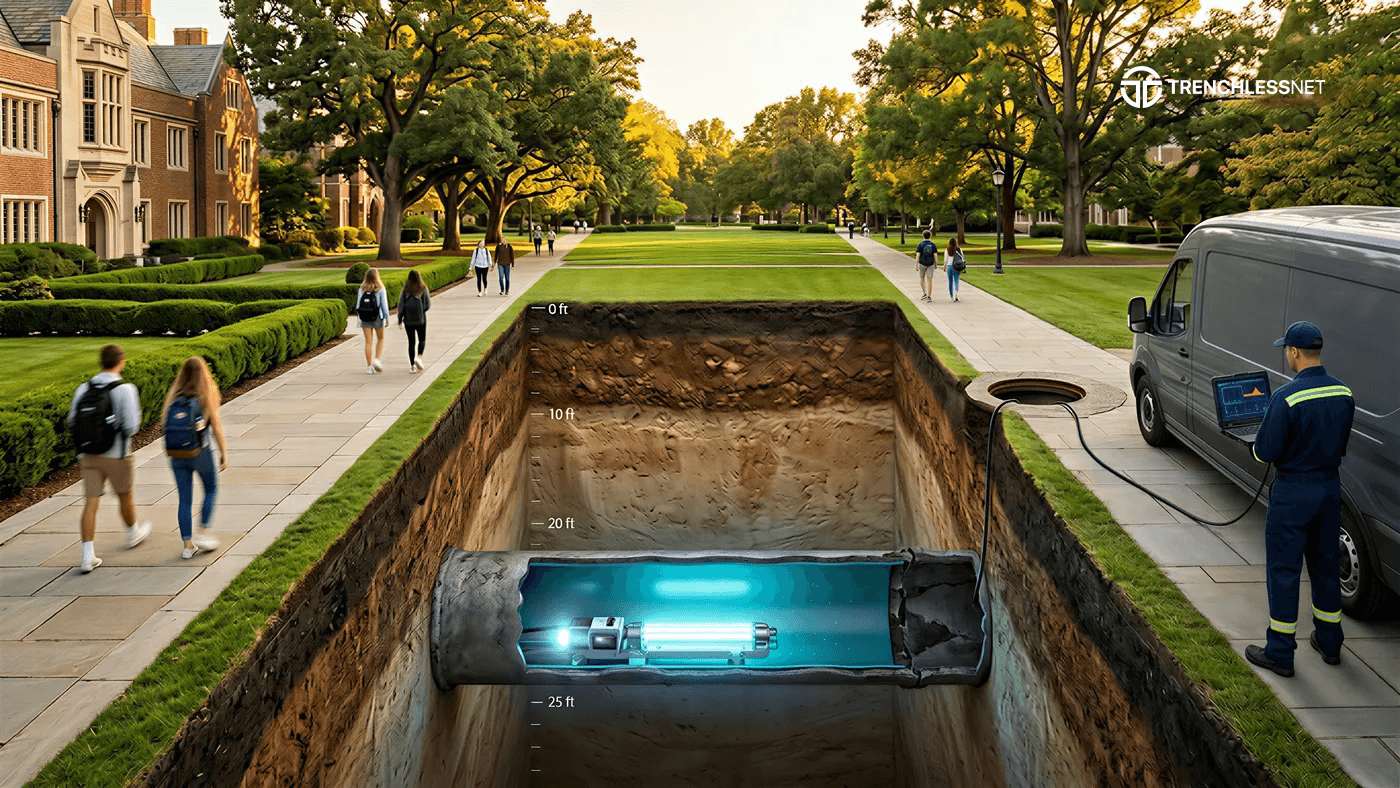
No-Dig Sewer Lining for a University | Pelican Underground
600 ft of failing sewer pipe restored 25 ft beneath a major university campus with UV-cured CIPP — one weekend, zero excavation, 50-year design life.
Project Overview
No-Dig Sewer Lining for a Major University — 600 Feet of Failing Pipe, Restored in a Single Weekend
When excavation wasn't an option near campus buildings, Pelican Underground used UV-cured GRP lining to restore 600 feet of sewer infrastructure 25 feet underground — completing the full rehabilitation over a single weekend with zero disruption to campus life.

Project Overview
- Client: Major Research University
- Location: St. Louis, Missouri
- Pipe Scope: 300 ft of 24-inch mainline + 300 ft of 12-inch pipe (600 ft total)
- Depth Below Surface: 25 feet
- Problem: New pipes with failing joint seals — infiltration and exfiltration risk adjacent to academic buildings
- Method: Structural UV-cured GRP Cured-in-Place Pipe (CIPP) Lining
- Contractor: Pelican Underground — Certified Saertex Installer
- Equipment: ProKASRO Professional UV Curing Unit
- Standards: ASTM F1216 / ASTM F2019 — NASSCO PACP inspection grading
- Time to Complete: 1 Weekend (single mobilization)
- Design Life: 50-Year Minimum (manufacturer-certified)
A Campus-Critical Repair With No Feasible Path to Open-Cut
Major research universities run on uninterrupted infrastructure. When 600 linear feet of sewer pipe at a St. Louis campus began showing premature joint-seal failures — creating both infiltration and exfiltration risk across the collection system — the facilities team faced a scenario where the standard playbook didn't apply. The pipes themselves were relatively new, but the seals had failed prematurely. And the pipes ran 25 feet beneath active academic buildings.
Traditional open-cut replacement would have required excavation to 25-foot depth immediately adjacent to load-bearing structures. The university's facilities team correctly ruled it out. Pelican Underground — a certified Saertex UV GRP installer in the TrenchlessNet contractor network — was engaged to deliver a structural rehabilitation using UV-cured CIPP lining, completing the full 600-foot restoration over a single weekend mobilization with zero excavation.
The Challenge: Three Obstacles That Ruled Out Conventional Repair
This was not a standard sewer repair. The combination of depth, proximity to structures, and space constraints created a scenario where traditional excavation was not viable — and the stakes were non-negotiable.
Obstacle 1 — Depth: 25 Feet Down
The failing sewer lines ran 25 feet below the surface. Excavating to that depth is a full civil engineering undertaking in its own right — requiring engineered shoring, confined-space entry protocols under OSHA 1926 Subpart P, significant heavy equipment, and mandatory dewatering coordination. At this depth, the cost and schedule gap between open-cut and trenchless rehabilitation typically exceeds the cost of the repair itself.
Obstacle 2 — Proximity to Campus Buildings
The pipe routes ran close to load-bearing campus structures. Digging at 25-foot depth in those locations carried a real risk of undermining building foundations — a risk the university's facilities team would not accept under any construction schedule. Geotechnical review flagged differential settlement potential in the soil layers adjacent to the foundation envelopes.
Obstacle 3 — Insufficient Working Surface Area
The excavation footprint required to safely access 25-foot-deep lines — including proper 1:1 or 1.5:1 slope benching under OSHA standards — would have exceeded the allowable working area on campus. There was simply not enough surface space to dig, even if the other obstacles had been solvable.
Why this constraint profile matters: Depth, structural adjacency, and constrained surface access are the three conditions that most frequently force institutional owners toward trenchless rehabilitation. For a full decision framework, see our replace vs. repair guide.
Pelican Underground's Approach: UV-Cured GRP CIPP
The chosen method was structural Cured-in-Place Pipe (CIPP) lining using Saertex UV-cured glass-reinforced polymer (GRP) liners — the liner system specified on demanding municipal and institutional rehabilitation projects worldwide. UV-cured GRP produces a higher flexural modulus per unit wall thickness than felt-based systems and cures substantially faster than hot-water or steam curing — the decisive fit for large-diameter rehabilitation on a compressed weekend schedule.
Why UV-Cured GRP Was the Right Choice
- Higher structural rating per unit wall thickness — a thinner liner achieves equivalent structural performance compared to felt-based CIPP, preserving more host-pipe hydraulic capacity.
- Faster cure times — a 300-ft run of 24-inch liner typically completes the cure cycle in 3–5 hours with UV, compared to significantly longer thermal cure windows.
- Lower styrene emissions during cure — a practical consideration on active campus environments with adjacent occupied buildings.
- Proven large-diameter performance — UV-cured GRP is the standard liner system on municipal mainline rehabilitation in North America and Europe.
- Manufacturer-certified 50-year design life — documented by Saertex per ASTM F2019 standards, giving the university a defensible long-term capital-life assumption.
The Equipment & Materials Chain
Pelican Underground operates as a certified Saertex installer, with Saertex UV GRP liners sourced directly and staged on-site at project mobilization. UV curing was performed using a ProKASRO Professional Curing Unit — the equipment calibrated on-site to deliver consistent UV dose across both pipe diameters in the single mobilization window. Pre- and post-lining documentation was captured using NASSCO PACP-graded CCTV inspection, providing the university with defensible before-and-after condition records across the full 600-foot scope.
The Execution: 600 Feet, One Weekend, No Trenches
The project was mobilized in a single weekend window, executing the following sequence:
- Pre-Lining Camera Inspection & Pipe Assessment. All 600 feet of pipe was inspected with a NASSCO PACP-graded CCTV system. Every failing seal was located and coded, internal geometry was verified at both diameters, and the baseline condition was established for warranty purposes.
- Liner Preparation & Equipment Staging. Saertex UV-cured GRP liners were measured, cut to length, and staged at the access point. The ProKASRO curing unit was calibrated on-site for consistent UV dose across both 24-inch and 12-inch diameters.
- Installation — 300 ft of 24-inch Mainline. The GRP liner was inserted into the 24-inch main through an existing access opening — no new excavation required. The ProKASRO UV light train was pulled through the liner, curing the GRP in place from the inside out to form a structurally independent, jointless new pipe within the host.
- Installation — 300 ft of 12-inch Pipe. The identical UV-cure process was applied to the 12-inch line. GRP material conforms precisely to the internal geometry of the host pipe, sealing all joints and defects without ground disturbance.
- Post-Cure Inspection & Verification. Final PACP-graded CCTV inspection documented liner adhesion, joint sealing, and structural integrity across the full 600 feet. The university received manufacturer certification confirming compliance with the 50-year design-life specification.
Dig vs. No-Dig: Why Trenchless Was the Only Viable Path
At this depth and building-adjacency profile, the open-cut-vs.-trenchless comparison was not a cost-per-foot discussion — it was a feasibility discussion. Here is how the two approaches measured against the specific university scenario:
| Factor | Traditional Excavation | UV-Cured CIPP (Chosen) |
|---|---|---|
| Feasibility near buildings | Not viable — foundation risk | Fully viable — no excavation |
| Surface working space | Exceeded allowable footprint | Existing access points only |
| Time to complete | Weeks to months | Single weekend |
| Campus disruption | Heavy equipment, closures, noise | Zero disruption |
| Landscape & hardscape | Lawns, walks, plazas destroyed | All surface features preserved |
| Design life | Depends on material & bedding | 50-year minimum (certified) |
| Structural adjacency risk | High — foundation undermining | None — no soil disturbance |
Project Results: 600 Feet Restored. One Weekend. Zero Trenches.
The project was delivered on schedule, within the allotted weekend window, with no disruption to campus operations, landscaping, or surrounding structures.
Time Compression
What would have required weeks or months of traditional excavation, shoring, dewatering, and surface restoration was completed in a single weekend mobilization.
Zero Campus Impact
No closures, no heavy-equipment traffic across walkways, no interruption to research or academic activity. Monday morning was indistinguishable from Friday evening.
Structural Safety Preserved
By eliminating all excavation, the risk of undermining adjacent building foundations was fully avoided — the facilities team's non-negotiable constraint.
50-Year Certified Service Life
Installed Saertex UV-cured GRP liners carry manufacturer-certified 50-year minimum service life, with significantly longer performance expected under normal municipal loading.
Why Institutional Owners Choose Pelican Underground
University campuses, hospital complexes, historic districts, and dense commercial cores share the same structural reality: the conditions that damage sewer infrastructure over time are the same conditions that make open-cut repair unacceptable. This project is a reference case for how UV-cured GRP CIPP handles that constraint set. The capability profile required is not generic. Pelican Underground brought the following to the job — each item publicly verifiable:
| Capability | Verification |
|---|---|
| Certified Saertex Installer | Manufacturer-authorized installer certification; prerequisite for 50-year design-life documentation |
| NASSCO PACP Certification | Pre- and post-lining CCTV grading to NASSCO Pipeline Assessment Certification Program standards |
| Large-Diameter CIPP Experience | 24-inch mainline rehabilitation — documented experience on municipal and institutional mains |
| ASTM Standards Compliance | ASTM F1216 (existing pipeline rehabilitation) + ASTM F2019 (GRP CIPP) — governing standards for the installation |
| ProKASRO UV Curing Equipment | Professional-grade UV curing system calibrated for multi-diameter single-mobilization installations |
| Full Trenchless Method Suite | CIPP lining, pipe bursting, spot repair — matched to defect condition |
| Regulatory Documentation | Pre-/post-inspection reporting aligned with EPA Clean Water Act I/I compliance requirements |
Frequently Asked Questions
Can UV-cured CIPP really line 24-inch mainlines in a single weekend?
Yes. UV-cured glass-reinforced polymer liners cure significantly faster than felt-based systems cured by hot water or steam. A 300-ft run of 24-inch pipe typically completes the cure cycle in 3–5 hours depending on wall thickness. Combined with pre-staged equipment and pre-lining inspection already performed, a weekend window is the norm for projects in this scope range.
How does UV-cured GRP compare with felt-based CIPP liners?
UV-cured GRP produces a higher flexural modulus per unit wall thickness than felt-based liners, meaning a thinner liner achieves the same structural rating. Cure times are also significantly shorter, and styrene emissions during cure are lower. Felt-based CIPP remains the economical choice for smaller-diameter residential laterals.
What does institutional CIPP cost per linear foot?
For large-diameter institutional CIPP like this project, typical U.S. pricing ranges from $180 to $400 per linear foot, scaling down with larger total scope and larger pipe diameters. Traditional open-cut replacement at equivalent depth typically ranges $600 to $1,400 per linear foot before surface restoration. See our full trenchless vs. traditional cost comparison.
What documentation does the institutional owner receive?
Standard deliverables include pre-lining NASSCO PACP-graded CCTV footage with defect coding, liner installation cure logs, post-cure PACP-graded CCTV verification, and manufacturer certification of compliance with the declared design life. On projects subject to EPA or state I/I compliance programs, the before-and-after PACP format satisfies regulatory submission requirements.
Does UV-cured CIPP work in all pipe materials?
Yes. UV-cured GRP CIPP is compatible with reinforced concrete pipe (per ASTM F2019), vitrified clay, ductile iron, cast iron, PVC, HDPE, and most other host materials. The pre-lining inspection confirms host pipe condition, ovality, and any spot defects requiring mechanical point repair before lining.
Does TrenchlessNet perform this work directly?
TrenchlessNet is a curated directory of qualified trenchless contractors. This project was executed by Pelican Underground, a certified Saertex UV GRP installer in the TrenchlessNet network. For similar scopes, see our contractor selection guide.
Have a Complex Pipe Rehabilitation Project?
Whether you manage university infrastructure, a commercial facility, or a municipal system, TrenchlessNet connects you with certified trenchless contractors with documented experience on projects at this scale.
Find a Qualified ContractorKey Outcomes
What would have required weeks or months of traditional excavation, shoring, dewatering, and surface restoration was completed in a single weekend mobilization.
No closures, no heavy-equipment traffic across walkways, no interruption to research or academic activity. Monday morning was indistinguishable from Friday evening.
By eliminating all excavation, the risk of undermining adjacent building foundations was fully avoided — the facilities team's non-negotiable constraint.
Saertex UV-cured GRP liners carry manufacturer-certified 50-year minimum service life, with significantly longer performance expected under normal municipal loading.
Project Results
Length Rehabilitated
600 linear feet (300 ft of 24-inch + 300 ft of 12-inch)
Timeline
Weeks to months vs. traditional excavation — completed in a single weekend
Related Topics
Need Similar Services?
Find contractors who specialize in pipe-lining and request a free quote.